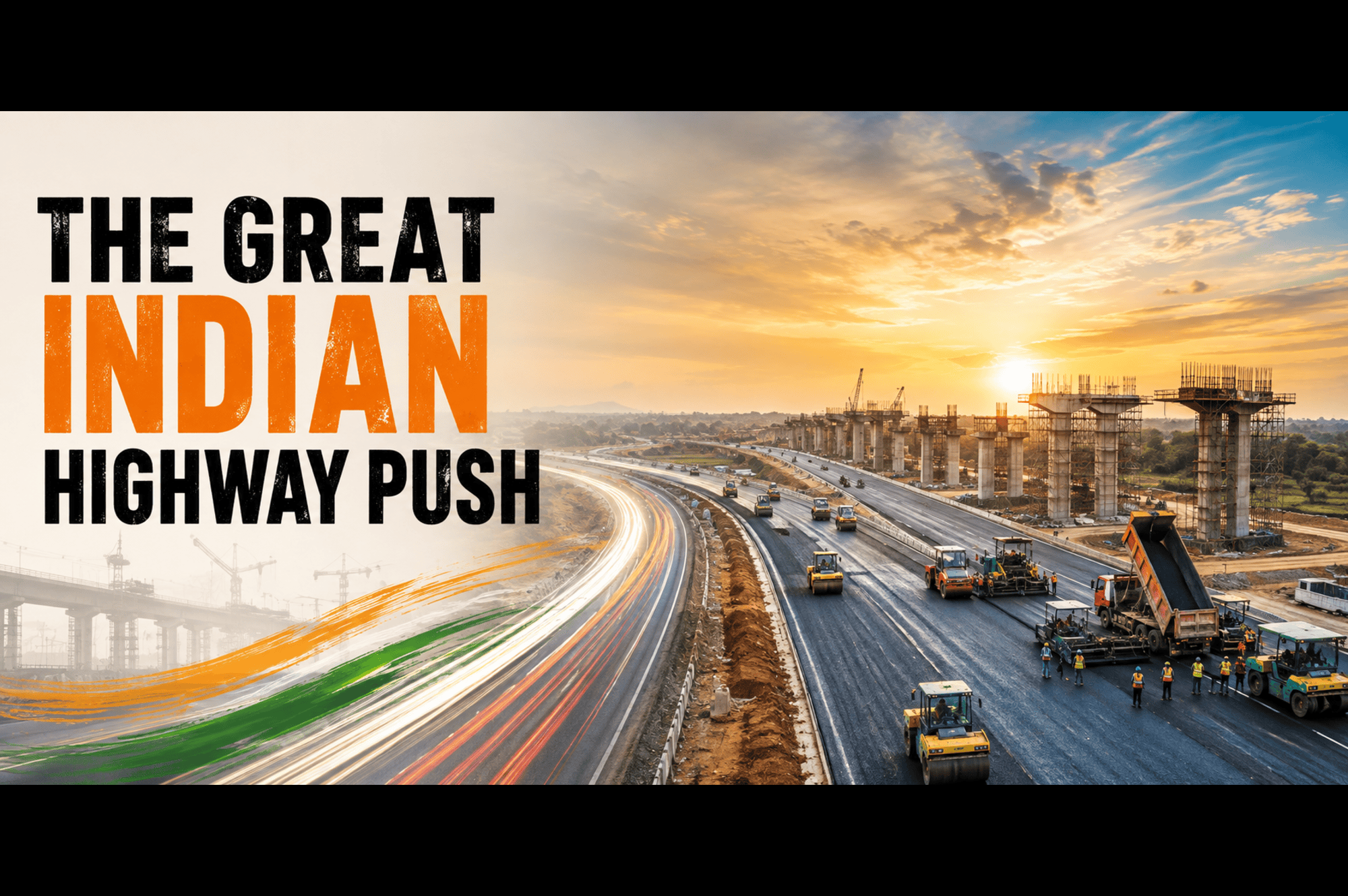
Roads & Highways: The Great Indian Highway Push

As Budget 2026-27 hands the roads ministry its biggest-ever outlay and the Delhi-Mumbai Expressway edges toward completion, India’s highway story is turning a corner — from laying kilometres fast to building them to last
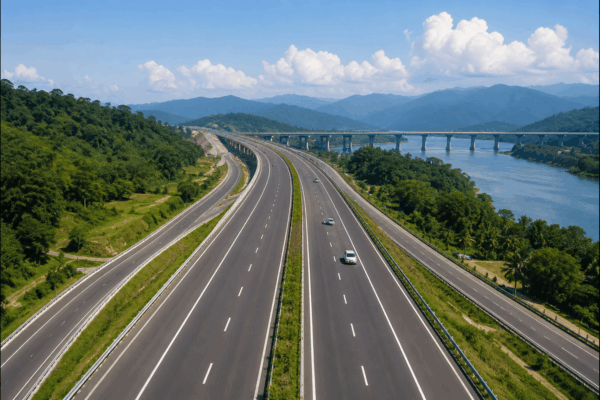
There is a particular kind of confidence that comes from watching a country pour concrete at scale. Drive out of Delhi towards Jaipur today and, within the hour, the frenetic, horn-heavy chaos of NH48 gives way to the eight-lane hush of the Delhi-Mumbai Expressway — India’s longest and, on completion, the world’s longest access-controlled highway. It is a fitting emblem for where the country’s road sector stands in 2026: not finished, not perfect, but unmistakably transformed from what it was a decade ago.
Roads carry roughly two-thirds of India’s freight and the overwhelming majority of its passenger traffic, making the humble highway arguably the single most consequential piece of infrastructure the country builds. This year, that reality is reflected squarely in the numbers coming out of North Block, in the pace of project execution, and in a policy shift that is quietly reshaping how India thinks about road-building — away from a single-minded chase of kilometres-per-day, and towards durability, safety and financial sustainability.
The Budget Signal: A Record Outlay, With Strings Attached
Union Finance Minister Nirmala Sitharaman’s 2026-27 Budget handed the Ministry of Road Transport and Highways (MoRTH) an allocation of roughly ₹3.09 lakh crore — about an 8 percent jump over the previous year’s outlay of close to ₹2.87 lakh crore, and easily the ministry’s largest-ever budgetary support. Of this, the National Highways Authority of India (NHAI) alone has been allocated close to ₹1.87 lakh crore, a sizeable increase meant to fund both new construction and, notably, debt reduction.
That last point matters more than it might appear. For years, NHAI leaned heavily on market borrowings to fund the highway-building boom, and its debt pile swelled as a consequence. The 2026 Budget explicitly targets bringing NHAI’s total debt below ₹2 lakh crore, easing the leverage overhang that had built up. Alongside this, the government has set a target of roughly ₹30,000 crore in asset monetisation for the year, split between Toll-Operate-Transfer (ToT) bundles and Infrastructure Investment Trusts (InvITs) — mechanisms that let the government recycle capital from completed, revenue-generating highways into fresh construction, rather than borrowing afresh each time.
The remaining chunk of the MoRTH allocation — roughly ₹1.22 lakh crore — goes towards roads and bridges under central sector schemes, covering national highway development, expressway construction, lane expansion, and connectivity works in left-wing-extremism-affected districts and the Northeast. The Border Roads Organisation, which builds strategically vital roads in border and hill states under the Ministry of Defence, has separately been allocated close to ₹8,900 crore for its central sector projects.
Taken together, the roads ministry now accounts for a meaningful share of the Centre’s total capital expenditure — a reminder that, budget after budget, roads remain one of the government’s most consistently backed infrastructure bets, regardless of the broader fiscal cycle.
From Speed to Substance: The Construction Pace Story
For much of the last decade, the pace of highway construction — measured in kilometres built per day — has functioned as the sector’s headline statistic, a number ministers cite the way cricket commentators cite run rates. It peaked at a record 37 km a day in the pandemic year of 2020-21, when the government pushed hard on construction even as much of the economy stalled.
That pace has since cooled. Road Transport and Highways Minister Nitin Gadkari has publicly acknowledged that construction has slowed to somewhere between 32 and 34 km a day in the current period, down from the roughly 40 km a day pace of a couple of years ago — a slowdown he has attributed partly to the fact that few fresh projects are currently being awarded under the flagship Bharatmala Pariyojana as the programme approaches the end of its original scope. Speaking at public forums through late 2025 and into 2026, Gadkari has set out a fresh ambition to push the pace back up to 60 km a day, and, further out, floated a longer-term aspiration of 100 km a day — a target he has framed as necessary if India’s highway network is to rival that of the United States within the coming years.
But alongside the pace conversation, a more consequential shift has been underway: a move from a purely quantitative target — kilometres awarded, kilometres built — to a qualitative one. The Ministry has signalled that new highway contracts will carry stricter penalty clauses for contractors who fail to meet quality benchmarks, and that project appraisal is shifting toward performance audits rather than financial audits alone, so that the durability of a road, not just the speed of its construction, becomes the yardstick of success.
That shift is visible on the ground, too. In February 2026, MoRTH launched a pilot deploying Mobile Quality Control Vans across Rajasthan, Gujarat, Karnataka and Odisha — vehicles equipped to conduct real-time, on-site quality assessments during construction rather than relying solely on inspections after a stretch of road is already built. It is a small initiative in scale, but it captures the sector’s current mood: less obsession with ribbon-cutting speed, more attention to whether the tarmac survives the monsoon.
Gadkari has also spoken candidly about a different constraint — not the ability to raise money, but the ability to spend it fast enough. Addressing the listing ceremony of an NHAI-sponsored Infrastructure Investment Trust on the stock exchange earlier this year, he noted that India has the capacity to mobilise up to ₹8 lakh crore annually for highway development, but flagged that the sector’s actual spending pace continues to lag behind what is financially achievable — an unusually frank admission from a minister not known for undersell.
The Delhi-Mumbai Expressway: India’s Longest Road Nears the Finish Line
No single project captures the scale of India’s highway ambition quite like the Delhi-Mumbai Expressway. Conceived as part of the Bharatmala Pariyojana, the roughly 1,350-1,386 km, eight-lane, access-controlled corridor threads through six states — Delhi, Haryana, Rajasthan, Madhya Pradesh, Gujarat and Maharashtra — and is designed to cut travel time between the capital and the financial capital from close to 24 hours down to around 12.
Responding to a written question in the Rajya Sabha in March 2026, Gadkari gave Parliament a detailed status update: the expressway is being built in 54 construction packages covering a total length of 1,445 km, of which 929 km had by then been operationalised. Within that, the Delhi-Vadodara stretch — spanning 912 km — had 697 km open to traffic, with 215 km still under construction and the full section targeted for completion by June 2026. The minister also flagged that delays in three packages in Gujarat, on the Vadodara-Mumbai stretch, had pushed those specific sections’ completion out to March 2028, even as the bulk of the corridor nears readiness — a candid acknowledgment that not every part of even the government’s flagship project has moved on schedule.
The corridor’s engineering has drawn its own share of attention: a design speed of 120 km/h, barrier-free Multi-Lane Free Flow tolling on its newer sections, and long elevated and tunnelled stretches through ecologically sensitive terrain, including a nearly five-kilometre twin-tube tunnel near the Mukundra Hills Tiger Reserve in Rajasthan meant to let the highway pass through a wildlife corridor with minimal disruption. Once fully through, the expressway is expected to meaningfully cut logistics costs and travel times along one of India’s busiest economic corridors, linking the National Capital Region to the ports and industrial belts of Gujarat and Maharashtra.
It sits alongside other expressway milestones the government has already banked: the roughly 701 km Mumbai-Nagpur Expressway (Samruddhi Mahamarg), built and operated by the Maharashtra State Road Development Corporation, reached full completion through 2025 after being rolled out in phases since 2022 — evidence that India’s expressway-building capability now extends well beyond the Centre’s own agencies to state road corporations as well.
Tolling Gets a Technology Upgrade
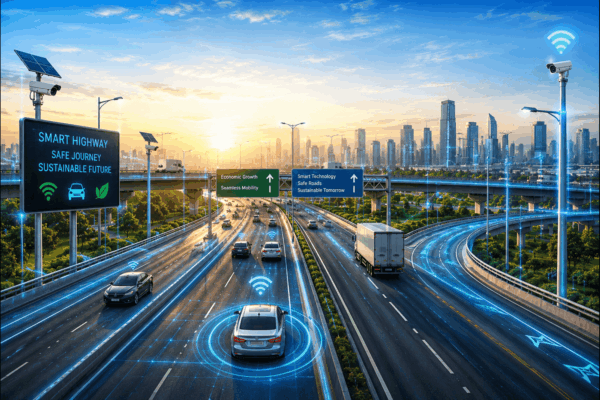
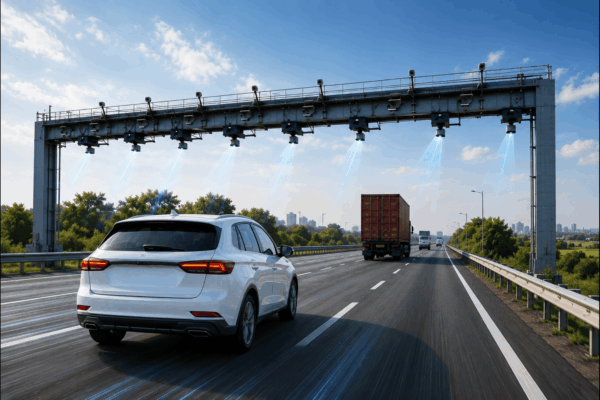
If the last decade of Indian highways was defined by FASTag — the RFID-based electronic toll system that all but eliminated cash queues at toll plazas after becoming mandatory in 2021 — the next phase is being built around GNSS-based satellite tolling, a system designed to remove toll plazas from highways altogether.
The concept is straightforward in principle: instead of a vehicle slowing down at a barrier, a GNSS On-Board Unit tracks the vehicle’s movement by satellite and calculates toll based on the exact distance travelled, while ANPR (Automatic Number Plate Recognition) cameras at virtual gantries serve as a compliance backstop for vehicles not yet fitted with the device. NHAI ran its first live Multi-Lane Free Flow pilot at the Chorayasi toll plaza on the Surat-Bharuch stretch of NH-48 in Gujarat in May 2025, letting equipped vehicles pass through at up to 80 km/h without stopping.
Addressing the Rajya Sabha, Gadkari told Parliament the system is being rolled out in a phased manner — commercial vehicles already fitted with Vehicle Location Tracking devices are being brought on first, with passenger vehicle integration to follow — and that the government’s stated goal is to have the satellite-based system operational across the country by the end of 2026. The minister told the House the shift is expected to save an estimated ₹1,500 crore in fuel currently wasted in toll-plaza queues, add close to ₹6,000 crore in annual revenue by plugging leakage from toll evasion, and — his words — bring waiting time at toll plazas down to zero for vehicles travelling at highway speed.
In the interim, the government has also tightened the electronic tolling ecosystem: cash lanes are being phased out at highway plazas under what is being described internally as a “zero-cash” push, and non-FASTag digital payments now attract a smaller surcharge than the earlier double-toll penalty, nudging remaining cash and UPI users toward full electronic compliance.
The Road Safety Reckoning
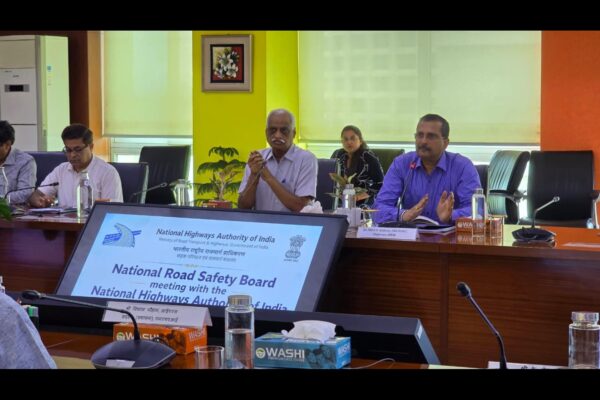
For all the expressway glamour, the sector’s most sobering numbers concern not construction but casualties. Speaking at a road safety event in New Delhi in early August 2026, Gadkari cited government data showing that 5,13,563 road accidents were reported by state and Union Territory police departments across the country in calendar year 2025 — a 5.3 percent rise over the previous year — claiming 1,83,382 lives. That works out, by the minister’s own reckoning, to roughly 59 accidents and 21 deaths every hour, a toll he has repeatedly said exceeds that of war or major disease outbreaks in terms of daily lives lost.
The data presented also breaks down where the risk concentrates: two-wheeler riders accounted for the highest share of fatalities at 46.2 percent, followed by pedestrians at 20.6 percent, and occupants of cars, taxis, vans and other light motor vehicles at 12.4 percent. Gadkari has specifically flagged helmet non-use among two-wheeler riders as a major contributor to preventable deaths, and pointed to changing public behaviour — rather than infrastructure alone — as the sector’s hardest problem to solve.
In response, the Ministry says it has identified 100 high-accident districts nationwide for targeted intervention on “black spots” — locations with a disproportionate concentration of crashes — and reiterated the government’s long-standing commitment, first made under the 2020 Stockholm Declaration, to halve road accident deaths by 2030. The government has also been rolling out the PM Rahat scheme, under which any road accident victim, regardless of the category of road on which the accident occurs, is entitled to cashless treatment worth up to ₹1.5 lakh for the first seven days after the crash — an initiative Gadkari has described as central to closing the “golden hour” gap that often determines whether a serious road injury proves fatal. The Ministry says it has also begun weaving road safety education into the school curriculum for Classes 10 and 12, betting that habits formed early will do more for the accident count than enforcement alone.
Gadkari has also put a number on what the crisis costs the country beyond the human toll: road crashes, he has said, shave off an amount equivalent to roughly 3 percent of India’s GDP every year — a figure he has used to argue that road safety spending should be seen not as a cost, but as an economic investment with among the highest returns available to policymakers.
Regional Connectivity and the Corridors Still to Come
Away from the marquee Delhi-Mumbai project, the Ministry has continued approving and upgrading regional corridors through 2026 — work that rarely makes national headlines but does much of the heavy lifting for local commerce. In early February, MoRTH proposed upgrading the 77-km Chitrakoot-Satna corridor, straddling Madhya Pradesh and Uttar Pradesh, from a two-lane road into a four-lane divided carriageway, aimed at strengthening inter-state freight movement. In the Northeast, the Ministry allocated dedicated funds under the Special Accelerated Road Development Programme (SARDP-NE) for road development in Assam and Arunachal Pradesh, including specific support for the regional offices in Guwahati and Itanagar tasked with executing these projects.
Gadkari has also spoken of longer-horizon ambitions still on the drawing board, including a proposed Mumbai-Bengaluru expressway that, he has said, could eventually bring travel time between the two cities down to around five hours — an early signal of where the next generation of India’s expressway network may be headed once the current pipeline of projects matures.
The Cabinet Committee on Economic Affairs (CCEA), chaired by Prime Minister Narendra Modi, added fresh momentum to this pipeline in the third week of August 2026, clearing a combined package of ₹13,041 crore in railway and highway projects spanning five states. Of this, ₹3,590.73 crore has been earmarked for four-laning the 82.57-km Muzaffarpur-Sitamarhi-Sonbarsa section of NH-22 in Bihar, to be developed under the Hybrid Annuity Mode and designed to strengthen road connectivity between Muzaffarpur and the India-Nepal border at Sonbarsa, linking into NH-27 along the East-West Corridor. The project includes seven major bridges — among them a 340-metre crossing over the Bagmati river — along with three railway overbridges and two flyovers. The remaining ₹9,450 crore has gone toward four railway multi-tracking projects adding roughly 410 km of capacity across West Bengal, Odisha, Andhra Pradesh and Tamil Nadu, all planned under the PM Gati Shakti National Master Plan and aimed squarely at decongesting the Howrah-Chennai freight corridor. The approval is a reminder that even as marquee expressways dominate headlines, the government continues to move on a steady drumbeat of smaller, state-specific road and rail sanctions that, cumulatively, do much of the work of stitching the country’s logistics network together.
The Ministry’s own medium-term pipeline, as outlined around the 2026 Budget, envisages developing roughly 13,400 km of highway projects under the public-private partnership model over the coming three years, backed by an estimated ₹8.3 lakh crore in investment — alongside a fiscal-year highway construction target of close to 10,000 km, a target the Ministry itself has framed as achievable only if quality benchmarks, not just kilometre counts, are met.
The Road Ahead
What emerges from a year’s worth of budget documents, parliamentary answers and ministerial statements is a sector in a deliberate transition. The first phase of India’s modern highway story — begun in earnest under the Golden Quadrilateral and accelerated through Bharatmala — was about proving that India could build roads fast and at scale. That case has largely been made: the national highway network has grown by roughly half since 2014, and the country now boasts, or will shortly boast, the world’s longest access-controlled expressway.
The phase now underway is a harder one to narrate in a single statistic. It asks whether roads built at speed will hold up over decades, whether the financial architecture behind them — debt, tolling, monetisation — can be made sustainable rather than merely large, and whether a country that builds highways this fast can also make them safe enough that using them doesn’t cost, on average, a life every three minutes. The answers to those questions, more than any kilometre-per-day figure, will determine what India’s roads actually deliver in the years ahead.
Tags