Smart Highways: The Road Renaissance

From AI-powered traffic systems to smart mobility corridors, India’s highways are undergoing a technological transformation that is redefining how people, goods, and economies move. EPC World News Bureau tracks the tech-empowered transitions reforming India’s roads and highway sector.
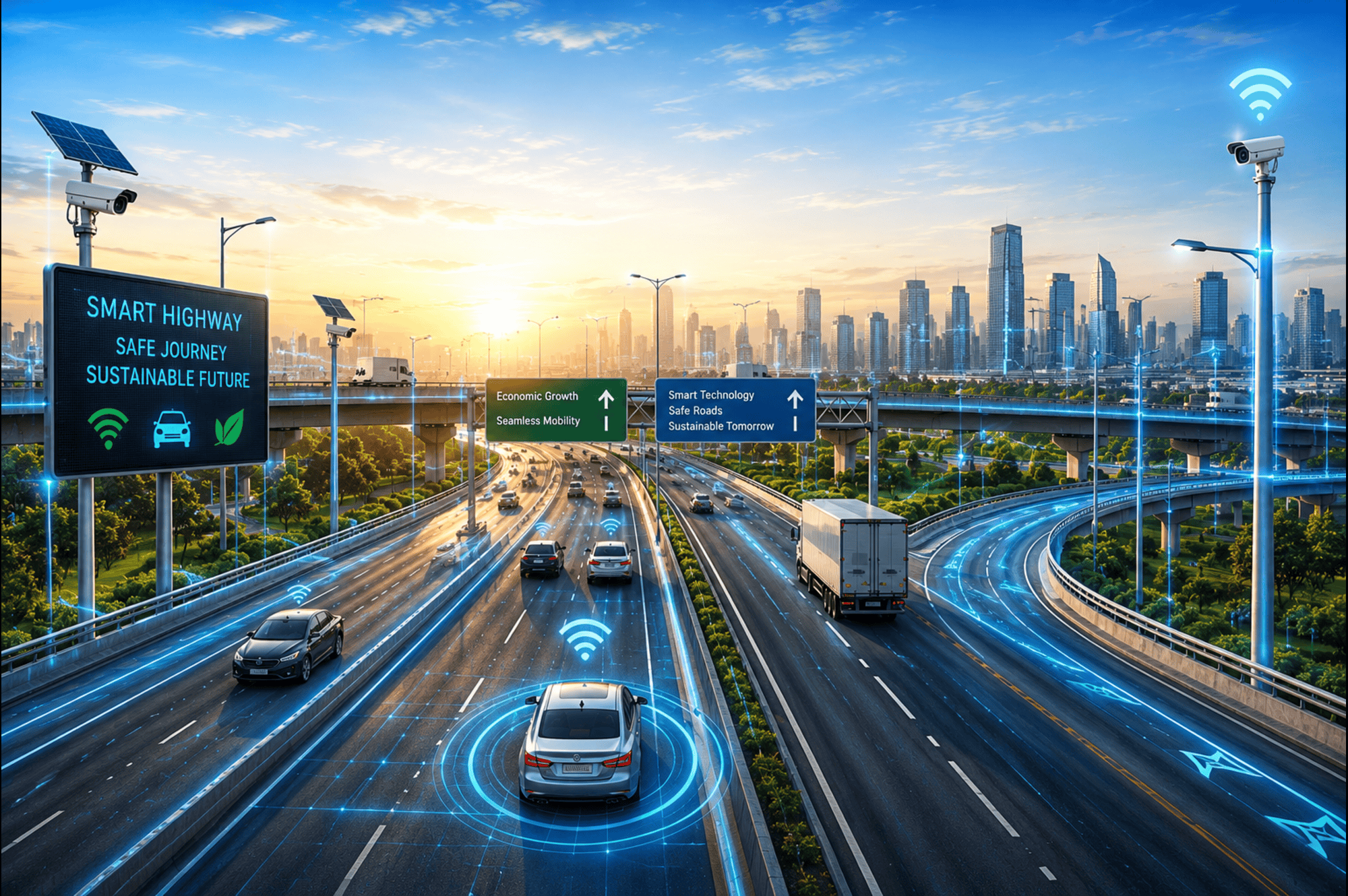
What if highways could think, communicate, and respond in real time? Across India, a quiet revolution is unfolding on the nation’s roads as infrastructure development enters a new era defined not just by scale, but by intelligence. From AI-enabled traffic systems and sensor-equipped corridors to seamless digital tolling and EV-ready expressways, the country is reimagining its transport network as a smart mobility ecosystem. As India charts its course toward Viksit Bharat 2047, roads are emerging as far more than physical connectors—they are becoming digital arteries powering economic growth and national competitiveness.
The transformation comes at a pivotal moment. With freight movement, urbanization, and passenger traffic expanding at an unprecedented pace, the focus has shifted from building more roads to building smarter ones. Policymakers, infrastructure developers, and technology providers are increasingly integrating intelligent transport systems, data analytics, green construction techniques, and multimodal logistics planning into road projects. The result is a new generation of highways designed to improve efficiency, reduce congestion, enhance safety, and support the transition to cleaner mobility.
Anchored by flagship initiatives such as PM Gati Shakti, the Bharatmala programme, and the National Highways Authority of India’s push toward digitally enabled infrastructure, India’s road sector is witnessing one of the most significant transformations in its history. Massive expressway developments, integrated logistics corridors, and innovative public-private partnerships are laying the foundation for a connected and sustainable future. As smart infrastructure moves from concept to reality, the nation’s highways are set to become powerful engines of productivity, investment, and inclusive development in the decades ahead.
Mapping the Transition
Roads have always played a critical role in connecting communities, facilitating trade, and enabling development, but their purpose and design have evolved significantly over time. What began as an effort to establish basic connectivity across a vast and diverse geography has today transformed into a mission to create intelligent, technology-enabled mobility networks capable of supporting one of the world’s fastest-growing economies. As India advances toward its vision of becoming a developed nation by 2047, highways are no longer viewed merely as transport corridors; they are increasingly being recognised as strategic assets that drive productivity, investment, sustainability, and digital innovation.
In the decades immediately following Independence, India’s infrastructure priorities were centred on nation-building and regional integration. Road development focused largely on expanding access to rural and underserved regions, ensuring that villages, towns, and emerging urban centres were connected to markets and administrative hubs. While significant progress was made in increasing road length, much of the network remained characterized by narrow carriageways, limited capacity, and inadequate maintenance. Highways primarily served as functional links for passenger and freight movement, with relatively little emphasis on efficiency, technology integration, or long-term mobility planning.
The economic reforms of the early 1990s fundamentally altered the trajectory of the sector. Liberalization accelerated industrial growth, increased domestic and international trade, and triggered rapid urbanization. As manufacturing output expanded and consumption patterns evolved, the demand for efficient transportation infrastructure grew exponentially. Existing road networks struggled to cope with rising freight volumes and increasing vehicle ownership, highlighting the need for a more modern and robust highway system. Policymakers began to view road infrastructure not merely as a public utility but as a critical enabler of economic competitiveness.
This shift in perspective gave rise to some of the most ambitious highway development programmes in the country’s history. The launch of the National Highways Development Programme (NHDP) marked a watershed moment in India’s infrastructure journey. Under this initiative, transformative projects such as the Golden Quadrilateral connected Delhi, Mumbai, Chennai, and Kolkata through high-capacity road corridors, while the North-South and East-West Corridors strengthened connectivity across vast stretches of the country. These projects dramatically reduced travel times, improved freight efficiency, and facilitated economic integration between regions. More importantly, they demonstrated how strategic investments in road infrastructure could generate multiplier effects across industries, agriculture, commerce, and employment.
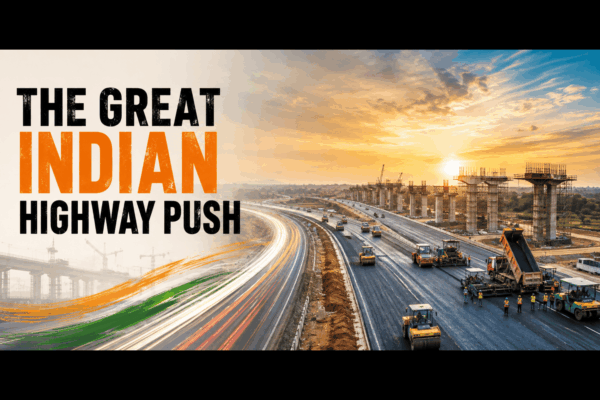
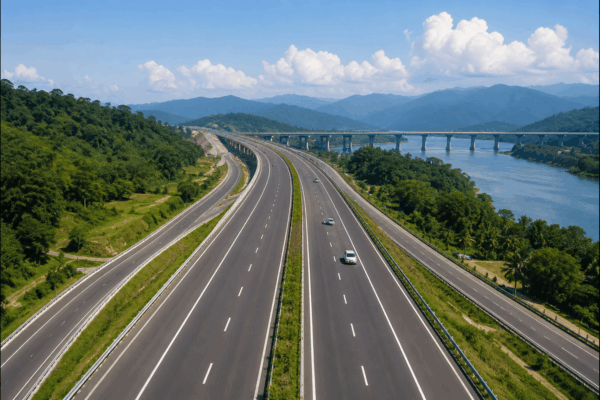
As India’s economy continued to expand through the 2000s and 2010s, the role of highways evolved further. Infrastructure planning increasingly focused on creating seamless freight corridors, improving last-mile connectivity, and supporting industrial development. The emphasis shifted from isolated road projects to integrated transportation networks capable of linking ports, logistics parks, airports, manufacturing clusters, and economic zones. Programmes such as Bharatmala Pariyojana sought to address critical infrastructure gaps while improving connectivity to border regions, coastal areas, and economic centres. The emergence of world-class expressways introduced a new paradigm in road transportation, providing controlled-access corridors designed for higher speeds, enhanced safety, and improved operational efficiency.
Yet the most significant transformation is unfolding today, as highways begin to embrace digital technologies and intelligent systems. The modern road is no longer a static physical asset; it is becoming a dynamic, data-driven platform capable of sensing, analysing, and responding to real-time conditions. This transition is being driven by the convergence of digital technologies, artificial intelligence, communication networks, and advanced engineering practices. Across the world, transportation infrastructure is moving toward smart mobility ecosystems, and India is increasingly positioning itself at the forefront of this shift.
The emergence of Intelligent Transport Systems (ITS) represents one of the most important milestones in this evolution. These systems combine sensors, cameras, communication devices, data analytics platforms, and artificial intelligence algorithms to enhance traffic management and road safety. Rather than relying solely on manual interventions, authorities can now monitor highway conditions in real time, detect incidents quickly, and implement corrective measures with greater speed and accuracy. Advanced traffic monitoring systems provide continuous data on vehicle movement, congestion levels, weather conditions, and road performance, enabling more informed decision-making. Such capabilities are helping transform highways into responsive networks that can adapt to changing traffic patterns and operational requirements.
Artificial intelligence is playing an increasingly important role in shaping the future of highway management. AI-powered analytics can process vast amounts of traffic data to predict congestion, identify accident-prone locations, optimise signal timings, and improve route planning. Machine learning models are also being used for predictive maintenance, enabling authorities to identify infrastructure vulnerabilities before they result in costly failures. Instead of reacting to road deterioration after it occurs, agencies can undertake preventive interventions, extending asset life while reducing maintenance costs. These capabilities are expected to become even more important as traffic volumes continue to grow in the coming decades.
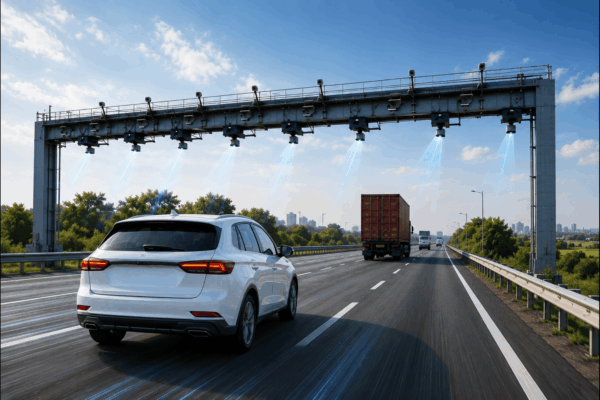
Digital tolling systems have emerged as another major component of India’s smart highway transition. Traditional toll plazas often created bottlenecks, increasing travel times and fuel consumption. The adoption of electronic toll collection technologies has significantly improved efficiency by enabling seamless transactions without requiring vehicles to stop. As digital tolling networks continue to expand, they are contributing to faster travel, reduced congestion, lower emissions, and improved user experience. The future may see even more sophisticated tolling mechanisms integrated with satellite-based tracking, geospatial technologies, and dynamic pricing models.
Road safety is another area where technology is driving meaningful change. Despite improvements in infrastructure, road accidents remain a significant challenge. Smart highways are increasingly being equipped with surveillance systems, emergency response mechanisms, automated incident detection technologies, and real-time warning systems. Integrated command and control centres can monitor vast stretches of road infrastructure, enabling rapid intervention during emergencies. In the future, connected vehicle technologies could allow direct communication between vehicles and infrastructure, warning drivers about hazards, weather conditions, or congestion ahead, thereby reducing risks and improving overall safety outcomes.
The transition toward electric mobility is also influencing highway design and planning. With electric vehicles expected to play a larger role in India’s transportation ecosystem, highways are being prepared to support charging infrastructure and associated energy requirements. Dedicated EV corridors, fast-charging stations, renewable energy integration, and smart energy management systems are gradually becoming part of infrastructure planning discussions. This convergence of transportation and energy infrastructure is expected to create new opportunities for sustainable mobility while reducing dependence on conventional fuels.
Sustainability has emerged as a defining principle in the next phase of highway development. Traditionally, infrastructure growth was assessed primarily through metrics such as road length and construction speed. Today, environmental performance is becoming equally important. Road agencies and developers are increasingly exploring the use of recycled materials, industrial waste products, waste plastic, fly ash, and low-carbon construction techniques. Green highways featuring solar-powered lighting, rainwater harvesting systems, biodiversity conservation measures, and energy-efficient technologies are gaining prominence. These innovations align with India’s broader climate objectives while ensuring that infrastructure expansion remains environmentally responsible.
Another significant development is the integration of highways into larger logistics and economic ecosystems. Through initiatives such as PM Gati Shakti, infrastructure planning is increasingly focused on multimodal connectivity. Roads are being linked more effectively with railways, ports, inland waterways, airports, logistics parks, and industrial corridors to create seamless supply chains. This integrated approach aims to reduce logistics costs, enhance freight efficiency, and improve the competitiveness of Indian industries in global markets. The road network is thus evolving from a standalone transport asset into a critical component of a digitally connected national infrastructure grid.
Looking ahead, the future of India’s highways is likely to be shaped by technologies that are only beginning to emerge. Vehicle-to-infrastructure communication, autonomous mobility solutions, digital twins, advanced geospatial mapping, drone-based monitoring, predictive traffic management, and smart asset management platforms could redefine how roads are planned, operated, and maintained. Highways of the future may be capable of communicating with vehicles, optimising traffic flows autonomously, generating renewable energy, and continuously monitoring their own structural health.
As India moves closer to its Viksit Bharat 2047 ambitions, the evolution of highways reflects a broader transformation in the country’s development philosophy. The objective is no longer simply to build more roads; it is to create smarter, safer, greener, and more efficient mobility ecosystems that can support economic growth while improving quality of life. From the construction of national highways that united the country to the emergence of intelligent transport corridors powered by data and technology, India’s road infrastructure journey illustrates how innovation is reshaping one of the nation’s most vital sectors. In the decades ahead, the success of the country’s mobility ambitions will depend not only on the kilometres of highways constructed but on how intelligently those highways connect people, industries, markets, and opportunities.
The Policy Push
India’s smart highway ambitions are no longer confined to pilot projects—they are now firmly embedded in the country’s infrastructure policy. Over the past few years, the Centre has repositioned roads from being standalone transport assets to digitally integrated economic corridors. Flagship programmes such as PM Gati Shakti, Bharatmala Pariyojana, the National Logistics Policy, and the National Infrastructure Pipeline (NIP) are converging to create a new generation of highways where digital technologies, intelligent transport systems (ITS), multimodal connectivity, and sustainable construction are integral to project planning rather than post-construction upgrades. The emphasis has shifted decisively from building more kilometres of roads to creating infrastructure that is smarter, safer, faster, and future-ready.
Backing this vision is an unprecedented financial commitment. In the Union Budget 2026–27, the Ministry of Road Transport and Highways (MoRTH) received an allocation of ₹3.10 lakh crore—an 8% increase over the previous year’s revised estimates—making it one of the largest infrastructure allocations in the Union Budget. Of this, ₹1.87 lakh crore has been earmarked for the National Highways Authority of India (NHAI) to accelerate highway development and modernisation, while ₹1.22 lakh crore has been allocated for roads and bridges. Equally significant is the rise in capital expenditure, which has surged from just ₹5,471 crore in 2012–13 to over ₹2.94 lakh crore in 2026–27, underlining the government’s long-term commitment to creating world-class transport infrastructure.
Policy reforms are also redefining how highways are planned, executed, and managed. The government’s focus has expanded beyond engineering excellence to include AI-enabled traffic management, GIS-based planning, electronic toll collection, drone-assisted monitoring, digital asset management, predictive maintenance, and integrated command-and-control systems. Through the PM Gati Shakti digital platform, infrastructure ministries now plan projects on a common geospatial framework, ensuring highways seamlessly connect with ports, airports, railways, logistics parks, and industrial corridors. Simultaneously, NHAI is accelerating the deployment of smart corridor management systems and strengthening quality norms to ensure that future highways are not only faster to build but also more resilient, data-driven, and commuter-centric.
The policy direction is clear: India’s highways are evolving into intelligent mobility corridors that will underpin the country’s economic aspirations over the next two decades. With sustained public investment, progressive regulatory reforms, and increasing participation from technology providers and private infrastructure developers, the government is laying the foundation for a transport ecosystem capable of supporting electric mobility, connected vehicles, autonomous technologies, and real-time traffic intelligence.
Navigating the Road Ahead
Despite the momentum behind India’s smart highway transformation, several challenges continue to shape the pace and scale of adoption. The integration of advanced technologies into road infrastructure requires significant upfront investment, robust digital ecosystems, and seamless coordination among multiple stakeholders. Variations in state-level implementation capacities, land acquisition complexities, project execution delays, and the need for continuous technology upgrades can slow progress. Additionally, as highways become increasingly data-driven, concerns surrounding cyber-security, data management, and interoperability between different systems will need to be addressed to ensure reliability and long-term effectiveness.
Equally important is the challenge of balancing rapid infrastructure expansion with sustainability and inclusivity. While smart highways promise greater efficiency and reduced environmental impact, ensuring equitable access to these benefits across regions remains critical. Future road development must account for evolving mobility patterns, climate resilience, electric vehicle adoption, and the needs of both urban and rural users. Investments in digital infrastructure, workforce upskilling, and institutional capacity building will be essential to maximise the value of technology-enabled transportation networks and prevent the emergence of infrastructure disparities.
Yet, the opportunities ahead far outweigh the obstacles. With strong policy support, sustained public investment, growing private sector participation, and rapid advancements in digital technologies, India is well positioned to leapfrog traditional models of road development. The next phase will require a strategic focus on integrated planning, intelligent asset management, green construction practices, and multimodal connectivity to create a truly future-ready transport ecosystem.
Tags