Concrete: Strengthened by Intelligence

Concrete has long been the foundation of modern infrastructure, valued for its strength and durability. Today, however, it is evolving beyond its traditional role. Advances in materials science, chemical admixtures, nanotechnology, artificial intelligence, and sustainable construction are transforming concrete into a smarter, more resilient, and environmentally responsible material. Tejasvi Sharma, Editor-in-Chief, EPC World, explores the innovations and technologies that are reshaping the future of concrete and infrastructure
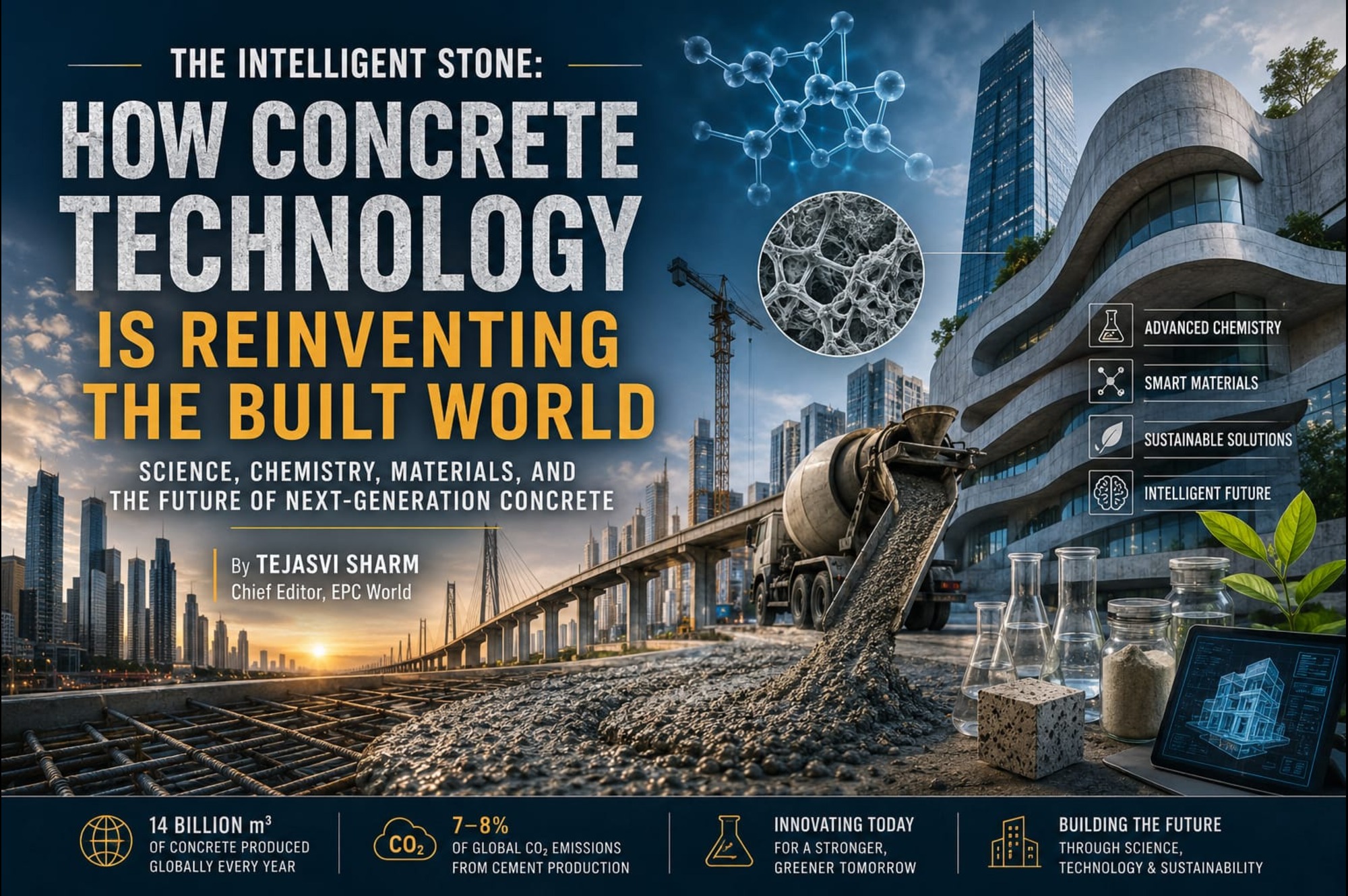
Concrete has been one of the most influential materials in human history, enabling everything from ancient Roman harbours to modern skyscrapers, bridges, and critical infrastructure. Today, the world produces around 14 billion cubic metres of concrete annually, while cement manufacturing accounts for nearly 7–8% of global CO₂ emissions, placing the industry at the centre of the challenge of balancing development with sustainability.
At the same time, concrete technology is undergoing a remarkable transformation. Modern concrete incorporates advanced chemical admixtures, supplementary cementitious materials, fibre reinforcement, self-healing capabilities, and even AI-driven mix design. No longer just a structural material, concrete is evolving into an intelligent, high-performance system designed for greater durability, sustainability, and efficiency. This transformation is reshaping the future of construction and infrastructure worldwide.
From Roman Innovation to Modern Concrete
The evolution of concrete technology dates back to ancient Rome, where builders combined volcanic ash, lime, and seawater to create remarkably durable structures. Research has shown that Roman marine concrete developed unique mineral formations that enabled it to strengthen over time, helping many structures survive for nearly 2,000 years in harsh marine environments. A major breakthrough came in 1824 when Joseph Aspdin patented Portland cement, creating a standardised and industrially scalable binder. Produced by heating limestone and clay to around 1,450°C, Portland cement delivered higher early strength and supported the rapid expansion of modern infrastructure. Throughout the twentieth century, the focus remained on increasing production and strength, laying the foundation for the advanced concrete technologies used today.
The Strength Revolution
Concrete technology has advanced significantly over the past century. Standard concrete grades have evolved from around 15 MPa in the mid-twentieth century to 25–40 MPa today, driven by improvements in water-cement ratio control, ready-mix concrete production, and chemical admixtures. The introduction of silica fume in the 1980s enabled compressive strengths of 80–100 MPa and beyond, transforming concrete into a highly engineered structural material. At the same time, the industry shifted its focus from strength alone to durability engineering. Modern concrete is now designed for long-term performance, with factors such as permeability, chloride resistance, carbonation, and freeze-thaw durability becoming as important as compressive strength in determining service life.
The Science Behind Strength and Durability
The performance of concrete is governed by the chemistry of Portland cement clinker, which consists mainly of four compounds: alite, belite, tricalcium aluminate, and tetracalcium aluminoferrite. Among these, alite is primarily responsible for early strength development, while belite contributes to long-term strength and lower heat generation. The hydration of these compounds produces calcium silicate hydrate (C-S-H) gel – the principal binding phase that gives concrete its strength and durability. The microstructure of C-S-H gel largely determines concrete performance. Factors such as water-cement ratio, supplementary cementitious materials (SCMs), and chemical admixtures influence its density and packing, directly affecting strength, permeability, and service life. However, concrete is also vulnerable to deterioration. Alkali-silica reaction (ASR) can cause internal expansion and cracking when reactive aggregates interact with alkalis in cement. Chloride ingress, particularly in marine and coastal environments, can trigger reinforcement corrosion, leading to cracking and spalling. Carbonation, caused by the penetration of atmospheric CO₂, lowers concrete alkalinity and increases the risk of steel corrosion. Understanding and controlling these mechanisms is essential for designing durable, long-lasting infrastructure.
The Chemical Admixture Revolution
Chemical admixtures have transformed modern concrete by enabling higher performance, improved durability, and greater construction efficiency. Among the most significant innovations are superplasticizers, particularly Polycarboxylate Ether (PCE)-based admixtures, which can reduce water demand by 20–40% while maintaining workability. These admixtures improve flowability, strength, and durability, while advanced formulations offer enhanced slump retention for hot-weather concreting and long-distance ready-mix transportation. Other specialised admixtures address key durability challenges. Shrinkage-reducing admixtures (SRAs) help minimise plastic and drying shrinkage cracks, improving the long-term performance of slabs, bridge decks, and industrial floors. Meanwhile, crystalline waterproofing admixtures react within the concrete matrix to form insoluble crystals that block pores and microcracks, reducing water ingress and providing a self-sealing effect in underground and water-retaining structures. Together, these technologies have elevated concrete from a conventional building material to a highly engineered construction system.
Supplementary Cementitious Materials
Supplementary Cementitious Materials (SCMs) have become essential to modern concrete technology. By reacting with calcium hydroxide produced during cement hydration, SCMs generate additional calcium silicate hydrate (C-S-H) gel, resulting in denser concrete with lower permeability, improved durability, and enhanced resistance to aggressive environments. Among the most widely used SCMs are fly ash, ground granulated blast furnace slag (GGBS), and silica fume. Fly ash improves long-term durability and sulphate resistance, while GGBS significantly enhances resistance to chloride penetration and is widely used in marine and infrastructure projects. Silica fume, owing to its ultrafine particles and high reactivity, is a key ingredient in high-strength and ultra-high-performance concrete (UHPC). Looking ahead, calcined clays and LC3 (Limestone Calcined Clay Cement) are emerging as promising low-carbon alternatives. LC3 can reduce CO₂ emissions by 30–40% compared to ordinary Portland cement while maintaining comparable performance. Geopolymer concrete, which replaces cement entirely with industrial by-products such as fly ash and slag activated by alkaline solutions, offers another pathway towards low-carbon construction, combining high strength with excellent chemical and thermal resistance.
Advanced Concrete Technologies
Ultra-High Performance Concrete (UHPC) represents the cutting edge of concrete technology, delivering compressive strengths of 150–250 MPa, exceptional durability, and near-zero permeability. Achieved through optimised particle packing, low water-binder ratios, silica fume, and steel fibre reinforcement, UHPC enables slimmer, lighter, and longer-lasting structures. It is increasingly used in bridges, high-rise buildings, and infrastructure rehabilitation projects where durability and structural efficiency are critical.
Self-Compacting Concrete (SCC), developed in Japan, revolutionised concrete placement by eliminating the need for mechanical vibration. Designed to flow and compact under its own weight, SCC easily fills complex formwork and heavily reinforced sections while maintaining uniformity. Its use has significantly improved construction quality, productivity, and safety, particularly in precast manufacturing, tunnels, bridges, and large infrastructure projects worldwide.
Pushing the Boundaries of Performance
Modern concrete technology has given rise to advanced materials that deliver exceptional strength, durability, and functionality. Ultra-High Performance Concrete (UHPC) achieves compressive strengths of 150–250 MPa and near-zero permeability through optimised particle packing, low water-binder ratios, silica fume, and steel fibre reinforcement. Its superior performance enables slimmer structural elements, longer spans, and extended service life in demanding infrastructure applications. Self-Compacting Concrete (SCC) has transformed construction by eliminating the need for mechanical vibration. Capable of flowing and consolidating under its own weight, SCC improves quality, productivity, and safety, particularly in heavily reinforced structures and precast manufacturing.
Another breakthrough is Engineered Cementitious Composites (ECC), a highly ductile material reinforced with synthetic fibres that can undergo significant deformation while developing only microscopic cracks. This enhances durability and makes ECC ideal for bridges, seismic structures, and repair applications. Meanwhile, self-healing concrete is bringing biomimicry to construction. By using specialised bacteria or chemical reactions to precipitate calcium carbonate within cracks, these systems can autonomously seal damage, improve durability, and reduce maintenance costs over a structure’s lifecycle.
Nanotechnology and the Digital Transformation of Concrete
Nanotechnology is enabling engineers to enhance concrete performance at the molecular level. Nano-silica improves strength, durability, and resistance to chloride penetration by refining the concrete microstructure and promoting the formation of additional C-S-H gel. Emerging materials such as graphene and carbon nanotubes offer further gains in strength, toughness, and durability, while also enabling the development of self-sensing concrete capable of monitoring its own structural condition. At the same time, digital technologies are transforming concrete design and quality control. Artificial intelligence (AI) is being used to optimise mix designs, reducing cement consumption while meeting performance and sustainability targets. Meanwhile, digital twin technology, supported by IoT sensors and real-time data analytics, allows continuous monitoring of concrete strength development and project performance, improving quality assurance, accelerating construction schedules, and reducing costs.
The Sustainability Imperative: Decarbonising an Essential Industry
Cement production remains one of the most carbon-intensive industrial processes, with clinker manufacturing responsible for the majority of emissions. Around 60% of cement-related CO₂ comes from limestone calcination, while the remaining 40% is generated by fuel combustion in kilns. To address this challenge, the global cement industry, through the GCCA Net Zero Roadmap, is pursuing clinker reduction, alternative fuels, energy efficiency, novel binders, and carbon capture, utilisation and storage (CCUS). Carbon mineralisation is emerging as a promising solution. Technologies such as CO₂ injection into fresh concrete permanently convert carbon dioxide into stable calcium carbonate, reducing emissions while improving concrete strength and enabling lower cement consumption. The industry is also advancing towards a circular economy through the use of recycled concrete aggregates (RCA). With nearly 900 million tonnes of concrete demolition waste generated annually, improved recycling technologies and evolving regulations are enabling RCA to be used in new structural concrete, reducing demand for virgin materials and lowering the environmental footprint of construction.
Scale, Challenges and Transformation
India is the world’s second-largest cement producer, with annual output exceeding 380 million tonnes, driven by massive infrastructure initiatives such as PM Gati Shakti, the National Infrastructure Pipeline, highways, metro rail projects, smart cities, and renewable energy expansion. This rapid growth is fuelling unprecedented demand for concrete. However, quality and durability remain key challenges. A large share of concrete is still produced through unorganised site batching, often with high water-cement ratios that compromise long-term performance. These issues are amplified by India’s demanding environmental conditions, including coastal chloride exposure, monsoons, temperature extremes, and sulphate-rich soils.
The growing Ready-Mix Concrete (RMC) sector is helping address these concerns through advanced batching systems, controlled admixture usage, and greater adoption of supplementary cementitious materials (SCMs). At the same time, revised BIS standards are increasingly emphasising durability-based design, although enforcement and compliance remain inconsistent across the sector. In major infrastructure projects, particularly marine and coastal developments, blended cement concretes incorporating GGBS and fly ash have become standard practice. These mixes offer significantly lower chloride penetration and improved durability, delivering substantial lifecycle cost savings despite slightly higher initial costs.
Concrete and the Economics of Infrastructure
Concrete is no longer judged solely by its initial cost. Infrastructure owners today increasingly evaluate projects based on lifecycle performance, maintenance requirements, and whole-life cost. A bridge, port, metro viaduct, or industrial facility designed for a 100-year service life can deliver substantial economic savings compared to one that requires major rehabilitation after only a few decades. This shift is driving the adoption of performance-based concrete specifications that prioritise durability, permeability, chloride resistance, and long-term structural reliability. While advanced materials such as SCM-rich concretes, UHPC, self-compacting concrete, and corrosion-resistant systems may involve higher upfront costs, they significantly reduce maintenance expenditure, operational disruptions, and carbon emissions over the life of the asset. For rapidly developing economies such as India, where trillions of rupees are being invested in roads, railways, ports, airports, renewable energy projects, and urban infrastructure, durable concrete is increasingly viewed as an economic necessity rather than a material choice. The industry’s focus is therefore shifting from building assets quickly to building assets that remain safe, resilient, and productive for generations. In this context, the future of concrete is not simply about higher strength – it is about delivering greater value, sustainability, and infrastructure longevity.
Concrete as an Intelligent, Active System
The next generation of concrete is moving beyond strength and durability towards intelligence, adaptability, and sustainability. Researchers are developing bio-concrete that uses microorganisms to heal cracks, repair damage, and potentially create self-renewing construction materials inspired by natural processes. Artificial intelligence is also transforming concrete design. By combining machine learning, advanced testing, and material science, researchers can optimise mix designs for performance, durability, and carbon reduction, uncovering formulations beyond the reach of traditional trial-and-error methods.
Smart concrete technologies are emerging as well. Conductive concrete can provide self-heating surfaces, structural health monitoring, and electromagnetic shielding, while future innovations such as energy-generating pavements and photovoltaic concrete could enable infrastructure to produce as well as consume energy. At the frontier, scientists are developing cementitious materials for lunar and Martian construction. Using local resources such as regolith and alternative binders, these technologies aim to support future space habitats while also offering lessons for sustainable construction in remote and resource-constrained environments on Earth.
Tags