Energy Security and Geopolitics: How a Fractured World is Rewriting the Economics of Infrastructure

by Tejasvi Sharma, Editor-in-Chief, EPC World
There was a time – not very long ago – when infrastructure planning could afford to be apolitical. Roads were built to connect cities, ports to move cargo, and power plants to meet rising demand. Energy, in that framework, was a variable – important, certainly, but largely predictable. Oil flowed through well-established routes, gas contracts spanned decades, and global markets, though imperfect, retained a degree of stability that allowed engineers and financiers to plan with confidence.
That era has ended.
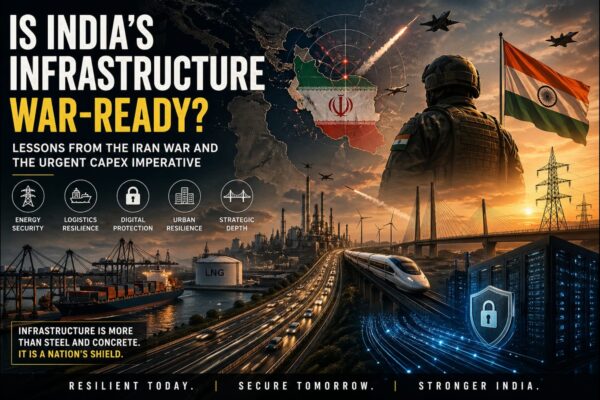
Today, infrastructure exists within a far more volatile ecosystem – one where energy is no longer merely a commodity but a strategic instrument. From the tightening choke points of the Strait of Hormuz to the recalibrated alliances emerging across Eurasia, the global energy map is being redrawn in real time. The consequences are profound, not only for national economies but for the very foundations of infrastructure development. Costs fluctuate with alarming frequency, execution timelines stretch unpredictably, and the calculus of investment has become inseparable from geopolitical risk.
For India, this shift is both a vulnerability and an opportunity. As one of the world’s fastest-growing economies and among the largest importers of crude oil, the country sits at the intersection of global energy flows. Every disruption – whether triggered by conflict, sanctions, or strategic realignments -reverberates through its infrastructure ecosystem. Yet, in responding to these challenges, India is also reshaping its development paradigm, transitioning toward a model that places energy security at the heart of infrastructure strategy.
The Fragility of Global Energy Systems
The illusion of stability in global energy markets has been shattered repeatedly over the past decade. The Russia-Ukraine conflict disrupted long-standing gas supply chains in Europe, forcing nations to scramble for alternatives in the LNG market. Tensions in the Middle East have periodically threatened the uninterrupted flow of crude oil through maritime chokepoints that handle a significant portion of the world’s energy trade. Meanwhile, supply chain disruptions—exacerbated by pandemic aftershocks—have exposed the fragility of interconnected systems once assumed to be resilient.
For infrastructure developers, these disruptions manifest in tangible and immediate ways. The cost of diesel rises, affecting construction logistics. Bitumen prices fluctuate, altering the economics of road projects. Steel and cement—both energy-intensive materials—experience price volatility that cascades through project budgets. What was once a predictable cost structure becomes a moving target, forcing contractors and developers into constant recalibration.
India’s dependence on imported energy amplifies these effects. With over 85% of its crude oil sourced from international markets, the country remains highly sensitive to global price movements. A sudden spike in oil prices can increase project costs across sectors, from highways to metro systems, from industrial corridors to urban infrastructure. Even when escalation clauses exist in contracts, they often fail to fully compensate for rapid market shifts, leaving contractors exposed to significant financial stress.
In this environment, energy is no longer a background variable—it is a central determinant of infrastructure viability.
Oil Volatility and the Rewriting of Infrastructure Economics
Oil volatility has always been a feature of global markets, but its impact on infrastructure has grown more pronounced as projects have become larger, more complex, and more capital-intensive. The traditional EPC model, built around fixed-price contracts and predictable timelines, struggles to accommodate the kind of price swings that have become increasingly common.
Consider the cascading effects of a sustained increase in crude oil prices. Transportation costs rise first, as fuel becomes more expensive for trucks, machinery, and logistics networks. This increase feeds into the cost of raw materials, particularly those derived from petrochemicals. Bitumen, a key input for road construction, becomes more expensive, directly affecting highway projects. Steel production costs climb due to higher energy inputs, influencing everything from bridges to industrial structures. Even cement, though less directly linked to oil, is affected through energy-intensive manufacturing processes.
The cumulative effect is significant. Margins in infrastructure projects—often already thin—are compressed further, forcing contractors to absorb costs or renegotiate terms. Financing becomes more complex, as lenders factor in energy price risk. Projects that once appeared viable may be delayed or shelved, awaiting more stable conditions.
What emerges is a new reality: infrastructure economics are no longer governed solely by engineering efficiency or financial modeling. They are increasingly shaped by the dynamics of global energy markets.
From Dependence to Determination: India’s Strategic Pivot
Faced with these challenges, India has embarked on a decisive shift—one that seeks to reduce vulnerability and enhance resilience. Energy independence, once an aspirational goal, is now a strategic imperative. This transformation is being pursued through a combination of policy initiatives, technological investments, and large-scale infrastructure development.
At its core, the strategy recognizes a simple truth: reliance on external energy sources exposes the economy to risks that cannot be fully controlled. By diversifying energy sources and strengthening domestic capabilities, India aims to insulate itself from global shocks while positioning itself as a more self-reliant and resilient economy.
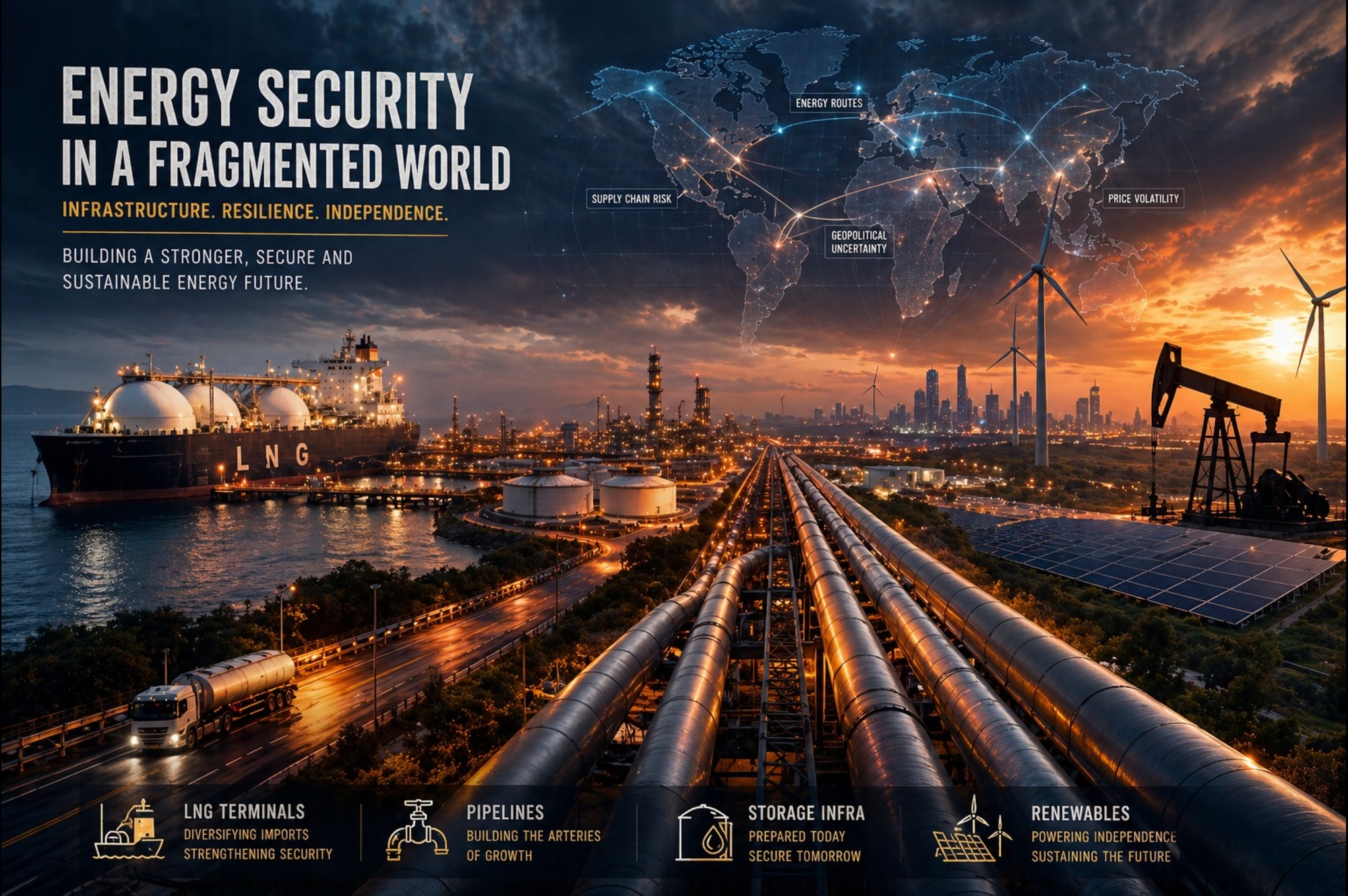
This shift is not limited to energy generation. It extends to the entire infrastructure ecosystem, influencing how projects are designed, financed, and executed. Renewable energy, LNG infrastructure, pipeline networks, and strategic storage facilities are no longer isolated components—they are integral elements of a broader energy security architecture.
Renewable Energy: Redefining the Infrastructure Landscape
The rise of renewable energy represents one of the most significant transformations in modern infrastructure. What began as an environmental initiative has evolved into a cornerstone of national strategy. For India, the expansion of solar, wind, and hybrid energy systems is not merely about reducing carbon emissions—it is about achieving energy sovereignty.
Renewable energy offers a fundamental advantage: it is largely immune to geopolitical disruptions. Sunlight and wind are not subject to international conflicts or supply chain constraints. By investing in these resources, India reduces its dependence on imported fuels while creating a more stable and predictable energy base.
The implications for infrastructure are far-reaching. Renewable systems require extensive transmission networks to connect generation sites—often located in remote areas—to consumption centers. Grid modernization becomes essential, as intermittent energy sources demand advanced management systems. Energy storage emerges as a critical component, ensuring reliability and continuity.
For EPC players, this transition opens up a vast and evolving opportunity landscape. Projects are no longer limited to traditional construction; they increasingly involve complex integration of technology, data, and engineering. The focus shifts from building static assets to creating dynamic systems capable of adapting to changing conditions.
LNG Terminals: Bridging the Transition
While renewables represent the future, the present demands a pragmatic approach. LNG has emerged as a critical bridge in the transition toward cleaner and more secure energy systems. Its flexibility, relatively lower emissions, and global availability make it an attractive alternative to crude oil and coal.
India’s push to expand its LNG infrastructure reflects this strategic thinking. New terminals are being developed along the coastline, equipped with advanced storage and regasification capabilities. These facilities enable the country to diversify its energy imports, reducing reliance on any single source or region.
The construction of LNG terminals is a complex undertaking. It involves specialized engineering, from cryogenic storage tanks to high-pressure pipelines. Safety systems must meet stringent standards, given the volatile nature of the fuel. Marine infrastructure, including jetties and berths, must be designed to accommodate large carriers under varying conditions.
For the EPC industry, LNG projects represent high-value opportunities characterized by technical sophistication and strong margins. They also signal a broader trend: infrastructure is becoming increasingly specialized, requiring expertise that extends beyond conventional construction.
Pipelines: The Quiet Backbone of Energy Security
If LNG terminals serve as gateways, pipelines are the arteries that distribute energy across the nation. Their importance cannot be overstated. By enabling efficient and continuous flow of natural gas, pipelines reduce transportation costs, enhance reliability, and support industrial growth.
India’s efforts to expand its pipeline network are driven by multiple factors. Urbanization increases demand for cleaner fuels, particularly in city gas distribution systems. Industries seek more efficient and less polluting energy sources. Power generation shifts toward gas-based plants to complement renewable energy.
Building pipelines, however, is not without challenges. Land acquisition remains a persistent issue, often delaying projects. Environmental clearances add complexity, particularly in ecologically sensitive areas. Security concerns arise in certain regions, requiring additional safeguards.
Despite these hurdles, pipelines remain indispensable. They represent long-term investments in energy infrastructure, providing stable and predictable returns. For EPC firms, they offer a steady stream of projects, each contributing to the broader goal of energy resilience.
Strategic Storage: Preparing for the Unexpected
In a world defined by uncertainty, the ability to store energy becomes as important as the ability to generate or import it. Strategic storage infrastructure acts as a buffer against disruptions, allowing countries to maintain stability even in the face of supply shocks.
India’s expansion of its strategic petroleum reserves reflects this understanding. By creating large storage capacities, often in underground caverns, the country enhances its ability to manage price fluctuations and supply interruptions. These reserves provide a critical cushion, enabling policymakers to respond more effectively to external pressures.
The construction of such facilities requires advanced engineering techniques. Geological conditions must be carefully assessed to ensure stability. Excavation processes must be precise, minimizing risks while maximizing capacity. Monitoring systems must be robust, capable of detecting and addressing potential issues in real time.
For the infrastructure sector, strategic storage projects represent a niche but highly valuable segment. They demand specialized skills and offer significant rewards for those capable of meeting their requirements.
Geopolitics and the Reconfiguration of Infrastructure
Energy security is not merely an economic concern—it is deeply intertwined with geopolitics. Infrastructure development, once driven primarily by domestic priorities, is increasingly influenced by international alignments and strategic considerations.
The concept of “friend-shoring,” where supply chains are aligned with geopolitical allies, is reshaping trade and investment patterns. Energy corridors are being developed not only for efficiency but for strategic advantage. Regional partnerships are emerging, enabling cross-border energy projects that enhance mutual resilience.
For India, this evolving landscape presents both opportunities and challenges. Strategic alliances can facilitate access to resources and technology, but they also require careful navigation of complex geopolitical dynamics. Infrastructure projects must be designed with these considerations in mind, balancing domestic needs with international commitments.
The Transformation of the EPC Industry
As the energy landscape evolves, so too must the EPC industry. Traditional models, focused on cost efficiency and execution speed, are no longer sufficient. The new environment demands a more holistic approach, one that integrates technology, risk management, and strategic insight.
EPC companies are increasingly becoming system integrators, responsible not only for construction but for the seamless functioning of complex infrastructure ecosystems. This requires investment in advanced engineering capabilities, digital tools, and specialized knowledge.
The shift also presents an opportunity. As infrastructure becomes more complex and valuable, the potential for higher margins increases. Companies that can adapt to these demands stand to gain significantly, positioning themselves at the forefront of a rapidly changing industry.
Conclusion: Building Resilience in a Fragmented World
Energy security has emerged as the defining challenge of our time. It shapes the economics of infrastructure, influences geopolitical alignments, and determines the trajectory of national development. In this context, infrastructure is no longer just about building assets—it is about building resilience.
India’s response to this challenge reflects a deep understanding of the stakes involved. By investing in renewable energy, expanding LNG infrastructure, strengthening pipeline networks, and developing strategic storage, the country is laying the foundation for a more secure and sustainable future.
For the infrastructure sector, this transformation represents both a test and an opportunity. The ability to navigate volatility, embrace complexity, and deliver high-quality solutions will determine success in the years ahead.
In the final analysis, the relationship between energy and infrastructure is symbiotic. Energy powers infrastructure, and infrastructure enables energy security. In a world marked by uncertainty, this interplay will define not only economic outcomes but the balance of global power.
And those who can engineer this balance—who can design systems that are not only efficient but resilient—will shape the next chapter of the global infrastructure story.
Tags