The $100 Trillion Reckoning: Capital, Climate, and the Convergence Economy

by Tejasvi Sharma, Editor-in-Chief, EPC World
How a once-in-a-century infrastructure supercycle is rewiring global capital flows — and placing India at the fulcrum of the next industrial era
The Concrete Awakening
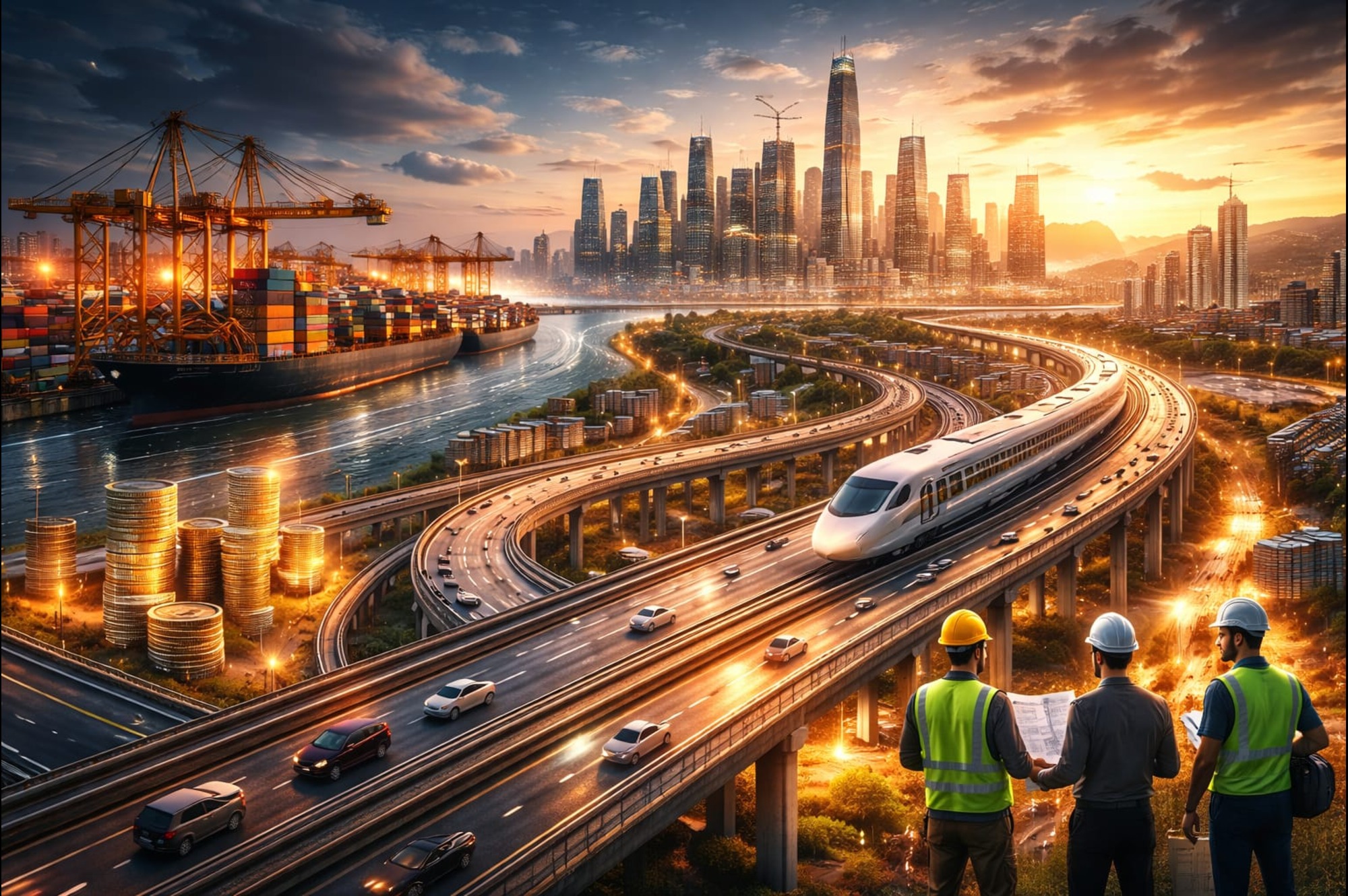
Between Houston’s LNG terminals and Mumbai’s coastal corridors, between Virginia’s data-centre alley and the lithium ponds of the Atacama, a quiet revolution is hardening into the world’s next economic foundation. The Global Infrastructure Hub estimates the world will require roughly $94 trillion in fresh infrastructure capital expenditure by 2040 to keep pace with demographic pressure, climate adaptation, and the metabolic demands of the AI age. Layer onto this the cumulative cost of decarbonisation — the IEA charts annual clean-energy capex toward $4.5 trillion by the early 2030s — and the figure breaches the $100 trillion threshold with uncomfortable ease.
This is not a pipeline. It is a tectonic realignment. After two decades during which advanced economies over-financialised and chronically under-built, the pendulum has swung violently toward the tangible. Asphalt, copper, transformers, gallium and silicon wafers have become the new strategic commodities, and balance sheets that once chased software multiples are quietly accumulating hard assets again. Nowhere is the inflection more pronounced than in India, where the EPC industry is being asked to compress into a single decade the physical transformation that the West executed across half a century.
A Macro Backdrop That Has Quietly Inverted
For policymakers and capital allocators, the central organising principle of the 2010s — abundant liquidity, disinflationary tailwinds, and a benign assumption of seamless globalisation — has expired. In its place stands a more austere triumvirate: structurally higher real rates, securitised supply chains, and a state that has rediscovered industrial policy with theological conviction. From America’s Inflation Reduction Act and CHIPS Act, mobilising over $850 billion of incentive capital, to the EU’s €300 billion Global Gateway, the developed world has reawakened to the fact that economic sovereignty is, at root, a function of physical assets owned, controlled and connected.
India enters this configuration with a rare alignment of macro variables. Nominal GDP is on course to cross $5 trillion by the end of the decade, fiscal capex has been front-loaded to a record ₹11.11 lakh crore in the most recent Union Budget — close to 3.4 per cent of GDP — and the National Infrastructure Pipeline has aggregated investment intent of approximately ₹111 lakh crore (around $1.4 trillion) across more than 9,000 projects. Gross fixed capital formation, stagnant below 28 per cent of GDP for nearly a decade, is climbing toward 31 per cent. For an economy that intends to triple its manufacturing base, electrify its transport spine and house an additional 250 million urban citizens by 2050, this revival of capex intensity is not stimulus. It is survival.
The Data Beneath the Narrative
Numbers, deployed with discipline, tell the story more honestly than slogans. India has commissioned national highway length at an average pace exceeding 12,000 kilometres per annum over the past five years, against a long-run average of barely 4,000 kilometres before 2014. Renewable capacity has crossed 200 GW and is sprinting toward the 500 GW non-fossil target by 2030. Domestic data centre capacity, under 600 MW in 2020, is projected to exceed 4 GW by 2030, attracting cumulative investment of more than $25 billion. Cargo handled at major ports has climbed past 800 million tonnes annually, even as container dwell times have compressed by nearly 40 per cent under the influence of digitised logistics.
Globally, hyperscale capex by Microsoft, Alphabet, Amazon and Meta is converging toward a combined annualised run-rate of $400 billion, more than the GDP of South Africa. Grid investment, long the Cinderella of the energy transition, is now forecast by BloombergNEF to require $24 trillion through 2050. Behind every elegant reference to artificial intelligence lies an inelegant truth: the AI economy is, in physical terms, an infrastructure economy of cooling towers, high-voltage interconnects and fibre conduits. The intangible runs entirely on the tangible.
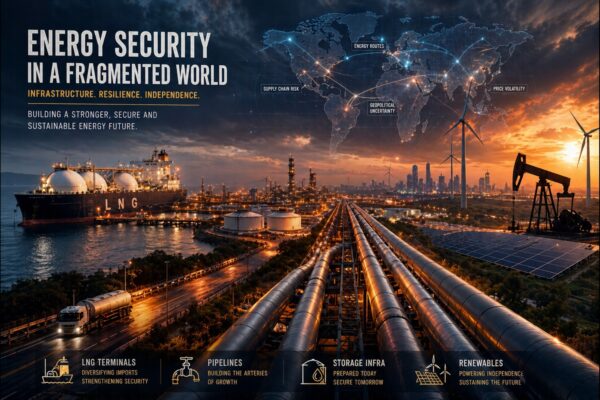
Energy Infrastructure: The Spine That Will Carry Everything Else
Of the four sectors carrying disproportionate weight in the current cycle, energy infrastructure is the load-bearing column. India’s energy transition will require cumulative investment estimated by CEEW and the IEA at $250–300 billion across renewables, transmission, storage and green hydrogen by 2030. The pivot is no longer about installing solar panels — that battle is largely won at unit economics under ₹2.5 per kWh — but about firming intermittent generation through pumped hydro, battery storage and, increasingly, small modular nuclear. The recently tendered 13 GWh of battery storage capacity, supported by viability gap funding, may prove a more historically significant intervention than any single solar park.
Transmission, the unsung discipline of the energy transition, is undergoing a renaissance. The Green Energy Corridor projects, the HVDC spine connecting Leh to Kaithal, and the inter-state transmission tariff-based competitive bidding pipeline together represent over ₹3 lakh crore of opportunity for EPC contractors and InvITs alike. The conversation has matured from megawatts to megawatt-hours and, increasingly, to megavolt-amperes. Without grid, no transition.
Digital Infrastructure: The Sector That Did Not Exist a Decade Ago
If energy is the spine, digital infrastructure is the nervous system being grafted onto it. Globally, the data centre asset class has graduated from a niche real-estate sub-segment into a trillion-dollar institutional category. Blackstone’s QTS, Brookfield’s Compass and DigitalBridge collectively command portfolios that rival the largest sovereign port operators. India is now the most attractive late entrant. Mumbai alone is projected to add over 1.5 GW of IT-load capacity by 2030, propelled by data localisation mandates, the Reliance-Brookfield-Digital Realty joint venture, and the gravitational pull of an internet user base exceeding 900 million.
Yet the deeper story lies in the AI-driven re-architecting of compute. Liquid-cooled, GPU-dense facilities consuming 80 to 130 kilowatts per rack — against a legacy norm of 6 to 10 — are forcing EPC firms to relearn mechanical, electrical and plumbing design from first principles. Power purchase agreements for hyperscale campuses are now being signed with twenty-five-year tenors, longer than most highway concessions. The convergence between digital infrastructure and energy infrastructure is now operationally indivisible. A data centre is, increasingly, a captive power project with servers attached.
Roads, Ports and the Logistics Lattice
The Indian highway story remains the most legible success of the current capex cycle, but its character is evolving. The Hybrid Annuity Model, which de-risked private participation after the BOT-toll fatigue of the previous decade, has matured into a refined instrument; close to 60 per cent of NHAI awards over the past three fiscal years have been routed through HAM, with EPC contracts reserved for the strategically critical and politically sensitive corridors. The asset monetisation pipeline, anchored by toll-operate-transfer bundles and the NHAI InvIT, has unlocked over ₹1.6 lakh crore of brownfield value, recycling capital into greenfield expressways such as the Delhi–Mumbai and Bengaluru–Chennai corridors.
The deeper transformation is multimodal. PM Gati Shakti, with its GIS-enabled integration of more than 1,600 data layers across sixteen ministries, has begun to dissolve the silos that historically converted infrastructure projects into archaeological exercises. The National Logistics Policy targets a reduction in logistics cost from approximately 14 per cent of GDP to single digits — a delta that, if achieved, would expand corporate earnings across manufacturing by 200 to 300 basis points. Dedicated freight corridors, Sagarmala and the modernisation of inland waterways are gradually constructing the logistics infrastructure that will determine whether India’s manufacturing ambitions remain aspirational or become tradable.
Urban Infrastructure: The Quietest Crisis, the Loudest Opportunity
Urbanisation is the demographic certainty against which all other forecasts must be calibrated. India will add more urban citizens between now and 2050 than the present-day combined population of Germany, France and the United Kingdom. Against this, the existing stock of metro rail (now over 950 operational kilometres across 21 cities), water and sanitation networks, and affordable housing remains structurally inadequate. The smart infrastructure agenda, once dismissed by sceptics as brochure-friendly euphemism, has matured into measurable outcomes: integrated command centres in over 100 cities, real-time water-loss monitoring in Bengaluru and Pune, and façade-integrated solar in newer municipal builds.
Yet urban infrastructure is also where the gap between intention and execution remains widest. Municipal finance, that perennial Achilles’ heel, continues to be undercapitalised; only a handful of urban local bodies issue meaningful municipal bonds, and property tax buoyancy remains weak. Without resolving the fiscal architecture of cities, the EPC industry will continue to build for governments that cannot afford to maintain.
Capital and Financing: The Quiet Institutionalisation of Indian Infrastructure
The infrastructure financing landscape has undergone a structural transformation that remains under-appreciated by mainstream commentary. Infrastructure Investment Trusts, virtually non-existent before 2017, now command assets under management of over ₹6 lakh crore across roads, transmission, telecom towers, gas pipelines and renewable platforms. The InvIT structure has done what Indian capital markets had failed to deliver for two decades: a credible, listed, yield-oriented vehicle for long-duration capital. Pension funds from Canada, sovereign wealth funds from Abu Dhabi, Singapore and Saudi Arabia, and Japanese life insurers have collectively deployed in excess of $50 billion into Indian infrastructure platforms over the past five years.
Private equity has evolved in parallel. KKR, Brookfield, Macquarie, GIP (now BlackRock) and CPP Investments have moved from opportunistic minority positions to controlling stakes in operating platforms — a sign of conviction that Indian assets can clear institutional hurdle rates on a fully de-risked basis. The National Investment and Infrastructure Fund has crossed $4.9 billion in committed capital. Crucially, the National Bank for Financing Infrastructure and Development, conceived to bridge the long-tenor gap left by commercial banks after the asset-quality crisis of the late 2010s, has begun sanctioning loans with twenty-to-thirty-year tenors that EPC contractors and concessionaires desperately require.
The asset monetisation pipeline of ₹6 lakh crore has consequently become the connective tissue between fiscal prudence and capex ambition: it allows the sovereign to fund greenfield development without breaching deficit guardrails.
Policy, Regulation and the Architecture of Trust
Infrastructure development at this scale depends less on engineering ingenuity than on the patient construction of institutional credibility. India’s policy ecosystem, after the chastening cycle of stalled projects and stranded assets that defined the early 2010s, has rebuilt itself around three quiet reforms: the Insolvency and Bankruptcy Code, which restored creditor confidence; RERA, which formalised counter-party discipline; and the increasing use of arbitration-friendly model concession agreements, which have reduced contractual ambiguity. The recent Vivad se Vishwas-II framework for contractual disputes promises to release tens of thousands of crores of stuck capital across the EPC industry.
Globally, the regulatory pendulum has swung toward strategic protectionism — but in ways that, paradoxically, may favour Indian EPC champions. As Western jurisdictions tighten FDI screens against Chinese contractors, and as the EU’s CBAM re-prices the embedded carbon of imported steel and cement, Indian firms with credentials in low-carbon construction and demonstrable governance hygiene stand to capture disproportionate share in Africa, Southeast Asia and the Gulf.
The Execution Reality: Where Strategy Meets Soil
For all the strategic exuberance, the execution layer remains where ambitions go to be tested. Land acquisition, despite procedural improvements under the 2013 Act, continues to absorb between 12 and 20 per cent of project timelines. Skilled labour shortages in welding, electrical and high-voltage commissioning trades are emerging as a binding constraint as multiple mega-projects compete for the same sub-contractor pools. Cost overruns on central-sector projects, while down from the 25 to 30 per cent norms of a decade ago, still average 10 to 12 per cent. Steel, cement and copper price volatility — sharpened by the Russia–Ukraine war and Red Sea disruptions — has compressed EPC contractor margins to the low single digits in some segments.
A more uncomfortable truth lies in working capital. Many tier-one and tier-two EPC firms continue to operate with debtor days exceeding 200, a structural fragility that any cyclical downturn would expose with brutal clarity. The maturation of the EPC industry into an institutional asset class will require not merely better contracts, but better balance sheets.
Technology Disruption: The Quiet Revolution Inside the Hard-Hat Economy
If the romantic image of infrastructure remains the bulldozer and the gantry crane, the contemporary reality is increasingly the digital twin and the autonomous compactor. Building Information Modelling, once a tick-box procurement requirement, is genuinely integrated into project workflows on the more sophisticated greenfield programmes — the Mumbai Trans-Harbour Link, the Navi Mumbai Airport, and several hyperscale data centre campuses. Drone-based progress monitoring, AI-assisted concrete maturity sensing, and predictive maintenance algorithms applied to operating road and power assets are no longer demonstration projects but procurement requirements.
The deeper disruption lies not in any single technology but in the convergence of design-build-operate workflows enabled by cloud-native common-data environments. The next generation of competitive advantage in the EPC industry will accrue to firms that compress the project lifecycle through digital integration, not headcount. Productivity in construction has lagged the broader economy for nearly fifty years; the AI-augmented project office may finally close that gap.
Climate, Resilience and the ESG Imperative
It is now analytically untenable to discuss infrastructure investment without explicitly costing climate. The physical climate exposure of Indian infrastructure — coastal corridors vulnerable to sea-level rise, transmission networks exposed to cyclonic intensification, urban drainage calibrated to obsolete rainfall norms — represents a balance-sheet liability that ratings agencies are only beginning to price. Resilient design, formerly a discretionary overlay, is rapidly becoming a fiduciary obligation.
On the mitigation side, the green premium for low-carbon cement, recycled steel and EV-compatible road furniture is narrowing more quickly than most boardrooms anticipated. India’s Carbon Credit Trading Scheme and the hardening of Scope 3 disclosures under the BRSR framework are converting climate from an externality into a line item. For sustainable infrastructure to scale beyond marquee projects, the EPC industry must internalise what economists have understood for a decade: carbon is a cost.
The Outlook: A Twenty-Year Horizon Reframed
Looking forward across the 2030s and into the 2040s, three structural shifts deserve disproportionate analytical attention. The first is the bifurcation of the infrastructure investment universe into legacy assets — roads, ports, conventional power — which will behave like mature, low-volatility utility yield, and frontier assets — green hydrogen, grid-scale storage, AI-grade data centres, semiconductor fabs, EV charging networks — which will command growth multiples and attract venture-style capital.
The second is the geographic redistribution of capex. As Western re-shoring intensifies and the Belt and Road Initiative recalibrates, India, Indonesia, Vietnam and select Gulf and African economies will absorb a disproportionate share of new infrastructure development. Indian EPC champions, with demonstrated ability to deliver complexity at competitive cost, are uniquely placed to internationalise.
The third is the integration of infrastructure into the broader algorithmic economy. The infrastructure asset of 2040 will be a sensored, data-emitting, dynamically-priced, financially-tradable cash-flow stream — closer in character to a security than to a structure. Capital, code and concrete will become genuinely indistinguishable.
A Closing Observation
For most of modern economic history, infrastructure was the patient ballast of national development — slow, capital-intensive, politically tedious, and intellectually unfashionable. That era is closing. In the convergence economy now taking shape, infrastructure has been promoted from background condition to strategic foreground: the medium through which the energy transition will be delivered, the substrate on which the AI economy will run, the buffer against an unstable climate, and the scaffolding of a multipolar order.
For India, the implication is unambiguous. The country is not merely participating in the $100 trillion supercycle; it is, in significant measure, defining the template by which large emerging economies finance, build and operate twenty-first century hard assets. The EPC industry, the InvIT ecosystem, the sovereign-pension-fund partnership architecture, and the policy stack from Gati Shakti to NaBFID together constitute a model that other geographies will study and selectively imitate.
The cement is wet and the capital is mobilising. The next decade will be remembered not for the volume of what was built, but for the quality of what was built to last. Those who can deliver — on time, on budget, and on planet — will inherit considerable strategic dividends. The convergence economy is not coming. It is already being poured.
Tejasvi Sharma is the Editor-in-Chief of EPC World. The views expressed are analytical and intended for senior executives, policy-makers and institutional investors engaged with India’s infrastructure trajectory.
Tags