Building Smarter, Greener Infrastructure Through Digital Innovation

by Rex Hariharan Thanasekar, Structural BIM Coordinator, EGIS-MESA
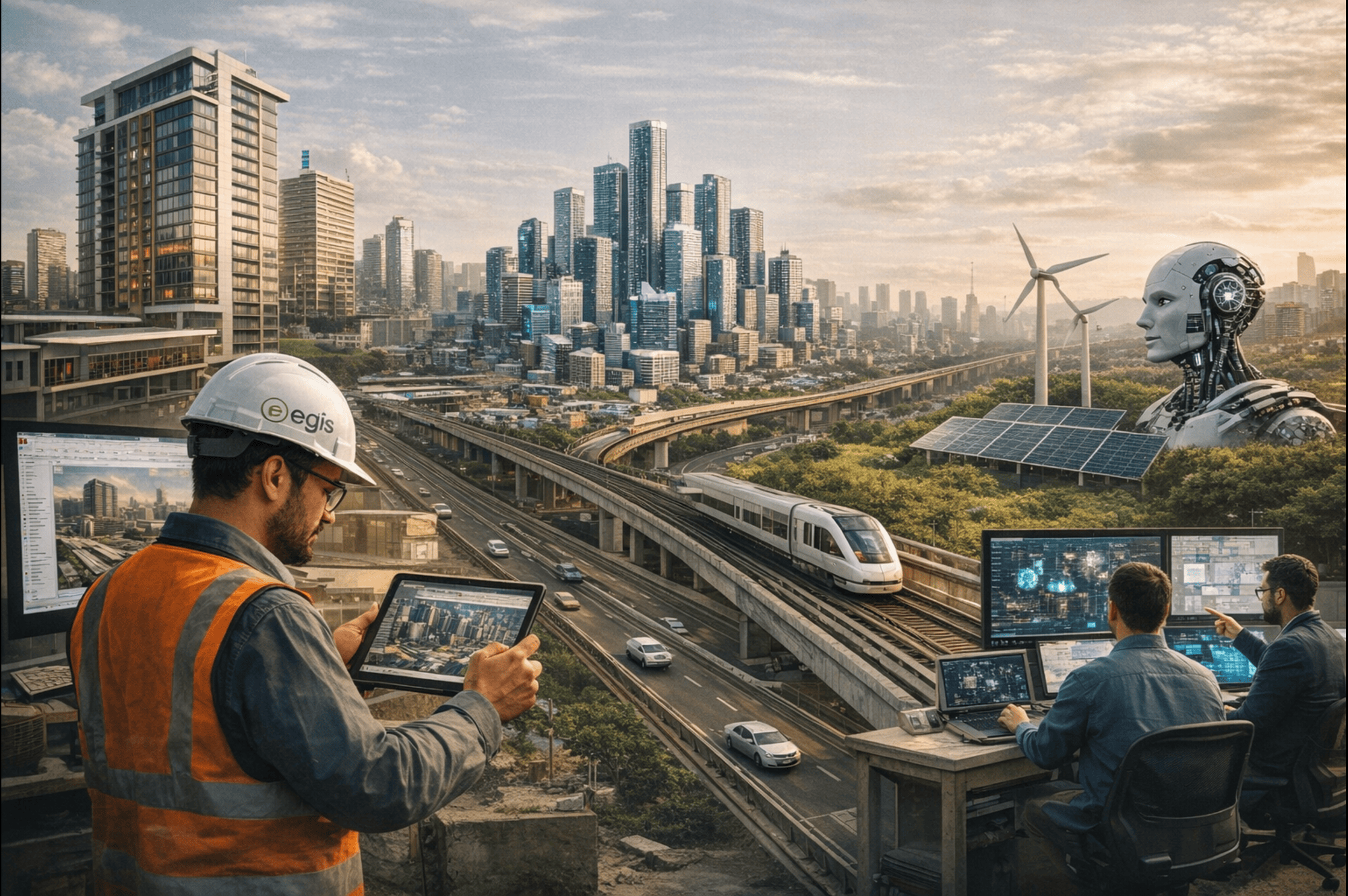
With the increasing complexity of infrastructure and urban development projects, technology has become the determining aspect in achieving accuracy, speed, and sustainability. Ranging from Building Information Modelling (BIM) to Digital Twin technologies and Artificial Intelligence (AI), Egis is leveraging innovation to transform the design, construction, and management of infrastructure in India.
BIM has transformed Egis’s way of working on project planning and lifecycle management. It is the digital backbone for coordination, accuracy, and collaboration across disciplines. Egis has a broad range of BIM software to guarantee that each stage of a project: Revit, AutoCAD, and Dynamo are employed for modelling and documentation purposes, whereas Navisworks is used for clash detection, quantity take-off, and time management simulations. For structural analysis, software like ETABS, SAFE, SP Column, and PROCON provide element-wise accuracy. Infrastructure and transportation projects utilize Civil 3D, InfraWorks, and ArcGIS, whereas Rhino and Grasshopper facilitate intricate parametric modelling and design optimization.
Project coordination starts from the Conceptual Design (CD) phase and continues up to Issue for Construction (IFC) documentation, such as authority approvals and tender preparation. Collaboration is made easier through ACC, a Common Data Environment (CDE), where project data is available to all stakeholders at anytime and anywhere. This integration improves accuracy, simplifies review processes, and enables multidisciplinary teams to operate in parallel, enhancing efficiency and minimizing rework. All the deliverables out from Egis are well coordinated to the corresponding stages & QA checks done on the submission files before releasing to concerned parties.
Egis actively encourages its BIM professionals to pursue recognized qualifications from esteemed Structural engineering institutions such as the Institution of Structural Engineers (IStructE) and the Institution of Civil Engineers (ICE) in the UK, as well as the Institution of Engineers (India) and leading mechanical bodies like IMechE and IET. This initiative fosters a culture of shared expertise and ensures that all team members are well-informed about current industry standards and protocols. BIM is fundamentally an engineering-driven process, and Egis ensures that all BIM personnel clearly understand their roles and consistently adhere to the BSI ISO 19650 standards.
Digital Twins
The company has done PoCs and has been supporting clients in developing their Digital Twin strategies. Such virtual models facilitate multi-level coordination, thereby cutting down on delays and costs. They also improve project bidding and acquisition by providing clients with a clear picture of design intent and execution planning. Apart from construction effectiveness, Digital Twins help with sustainability by making it possible to calculate and track the carbon footprint of buildings, ensuring green-oriented designs. Site teams enjoy real-time access to precise data regarding design codes, material grades, and construction specifications, which improves compliance and safety. Egis also uses wind simulation and structural analysis models to predict future climate trends, designing resilient infrastructure that can withstand thermal and wind fluctuations over time.
AI and Machine Learning – Automating Intelligence Across Workflows
At the core of Egis’s digital transformation lies its Digital Innovation and Technology (DIT) team, which spearheads automation and integration of intelligence into multiple project workflows. The team is tasked with minimizing laborious and repetitive tasks and optimizing speed without sacrificing quality. The design analysis model and the corresponding calculations are systematically correlated and seamlessly integrated using DIT tools and solutions. With the creation of Revit APIs, Dynamo scripts, and Grasshopper codes, the team at DIT streamlines much of the repetitive design and modelling tasks, allowing the specialists to spend more time on high-value activities like design creativity and troubleshooting.
Moreover, through the integration of Revit APIs, Dynamo scripts, and Grasshopper codes into the BIM framework, the team at DIT automates a significant portion of repetitive modelling and documentation processes, enhancing efficiency and allowing specialists to concentrate on design optimization and issue resolution.
Egis is also developing its own proprietary AI platform, an adaptive system that utilizes AI and Machine Learning to study data from previous projects, extract best practices, and develop consistent design methodologies. These insights based on AI facilitate accelerated structural analysis, minimize the risk of human error, and facilitate predictive modelling for future infrastructure needs. The incorporation of AI tools in structural verification also enhances safety, compliance, and project reliability.
Sustainability and ESG
Egis applies BIM to track and reduce carbon footprints and ensure that infrastructure projects meet green building regulations. The incorporation of sustainable building materials as well as resource-efficient design practices aids further in this initiative. The use of digital tools also optimizes costs, advocating economic efficiency and contributing to local communities through sustainable development. Through technology use in inclusive design, Egis provides accessibility and safety for everyone to design infrastructure that is technically superior as well as socially sound.
In addition, the integration of innovation and sustainability creates a setting where innovative solutions thrive, providing avenues towards more intelligent, more responsive urban design. The union of BIM, Digital Twin technologies, AI, and sustainability-influenced innovation is more than a technological transition for Egis — it is a philosophy of advancement. In adopting digital capabilities, Egis continues to provide infrastructure that is efficient, resilient, and future proof.
Tags