
Budget 2026 and the Infrastructure Industry: A Capex Gospel, with Fine Print

by Tejasvi Sharma, Editor-in-Chief, EPC World
I write this on a Budget Sunday that did not merely announce numbers; it attempted to script a mood – an engineered optimism for an industry that lives and dies by visibility, velocity, and the weary arithmetic of cash-flow. If infrastructure is the Republic’s most expensive form of belief, then Budget 2026 has once again placed the State as the principal liturgist – dispensing capital expenditure as both stimulus and signal, while quietly reminding the market that discipline, not exuberance, will define the fiscal temperament.
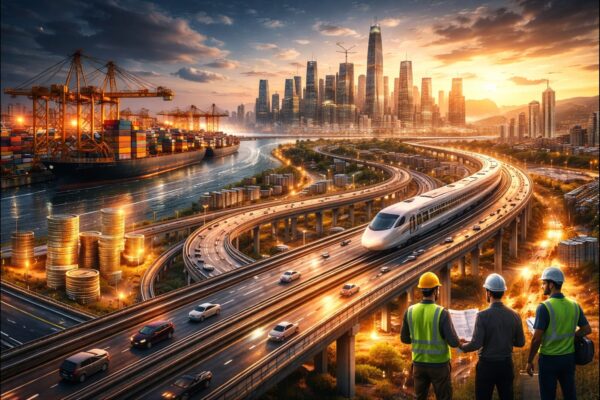
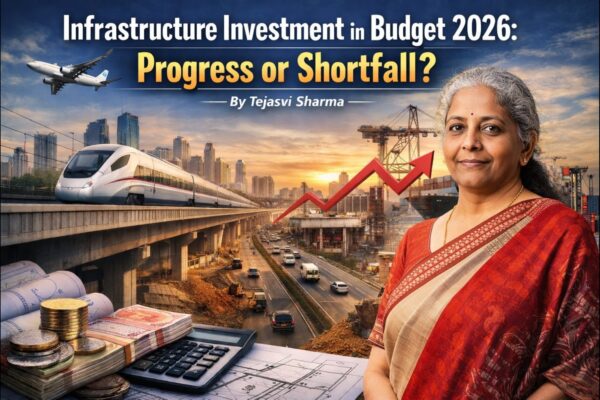
The headline, as the contracting universe will inevitably repeat across tender rooms and boardrooms, is straightforward: the Union has set a record infrastructure spend of about ₹12.2 trillion for FY2026–27, an annual increase of roughly 11.4%. The implication is equally unmistakable: the government is not retreating from the capex-led growth doctrine that has, for several years now, functioned as India’s macroeconomic exoskeleton. Yet, like all consequential budgets, the true story is not the headline. It is the transmission mechanism – how the outlay translates into awards, execution, procurement cycles, claims, arbitration, working capital, equipment deployment, and, ultimately, tangible assets that citizens can use rather than merely admire in brochures.
The first-order effect: order books will thicken, but selectivity will intensify
A capex-heavy budget is oxygen for EPC contractors, capital goods manufacturers, and infra developers – particularly those calibrated for highways, urban mobility, rail systems, public buildings, and network infrastructure. In the immediate aftermath, the market’s reflex is to reward the companies that sit closest to the spending nozzle; even Reuters noted gains in select capital goods and infrastructure names on the back of the announcements. But the deeper, operational effect will be a renewed thickening of the tender pipeline – more packages, more clusters, more hybrid models, and, if the implementing agencies behave, more predictability in award cadence.
However, this will not be a free-for-all. The budget also tacitly acknowledges the reality of absorption capacity: revised estimates for the ongoing year’s capex were trimmed (a reminder that announcing is easier than executing). This is not a moral failing; it is a logistical one – land, approvals, utility shifting, design finalisation, and contractor bandwidth remain the unglamorous chokepoints. The industry should therefore expect a more Darwinian marketplace: contractors with stronger project controls, claims hygiene, and supply-chain sovereignty will widen the gap versus those who merely win bids.
The second-order effect: working capital will become the decisive battlefield
Budget 2026 arrives with an insistence on fiscal consolidation – fiscal deficit targeted at about 4.3% of GDP in BE 2026–27. This matters for infrastructure because capex is not merely an expenditure line; it is a cash-flow choreography between the sovereign, its agencies, the banking system, and the contractor community. When deficits are constrained, the State’s ability to “overpay” delays through informal liquidity is diminished. Payments can still be timely – indeed, they must be – but the system becomes less forgiving of inefficiency.
For the industry, the prescription is unsentimental: strengthen balance sheets, shorten receivable cycles, professionalise billing, and treat contract administration as a profit centre rather than paperwork. Contractors who continue to treat escalation, variation orders, and claims as afterthoughts will discover that high capex does not automatically mean high cash. It means high activity – and activity can be ruinously expensive if it is under-financed.
The third-order effect: logistics and corridors are being positioned as national productivity infrastructure
One of the most consequential subtexts of Budget 2026 is the continued elevation of integrated corridor thinking – where roads, rail, ports, industrial nodes, and urban clusters are orchestrated into a single productivity architecture. The government’s own summary points to an integrated East Coast Industrial Corridor with a well-connected node at Durgapur. For infrastructure companies, corridors are not mere geography; they are multi-year annuities of civil works, structures, MEP, station packages, logistics parks, warehousing, and last-mile linkages.
This corridor logic changes how the industry should think about opportunity. The winners will not be those who chase isolated projects, but those who build corridor-specific dominance – local vendor ecosystems, quarry linkages, fabrication partners, and manpower pools that reduce execution friction. In other words, in the coming cycle, “regional depth” may describe competitive advantage more accurately than “pan-India presence.”
Urban mobility is quietly being reframed as an electrification and services story
Budget statements around e-buses – such as the provision for 4,000 e-buses—may look modest in isolation, but they represent a strategic pivot. Urban mobility is being increasingly framed not only as civil infrastructure, but as systems infrastructure. Depots, charging networks, grid upgrades, intelligent transport systems, and O&M frameworks begin to matter as much as flyovers and asphalt.
For traditional contractors, this is both a warning and an invitation. The industry’s comfort zone – earthwork, structures, pavements – will remain crucial, but the margin gravity is shifting toward integration: electrical packages, automation, data, monitoring, and long-term maintenance. Those who do not evolve will still find work, but they may increasingly find themselves commoditised.
Manufacturing adjacency: infrastructure will be asked to “serve industry,” not just “serve mobility”
Reuters observes that the budget makes a fresh bet on manufacturing alongside capex. Manufacturing is the most infrastructure-hungry form of growth: it demands reliable power, water, freight capacity, industrial land, and resilient logistics. When manufacturing becomes the co-equal protagonist, infrastructure planning changes temperament – fewer vanity projects, more throughput projects; fewer symbolic assets, more enabling assets.
The fine print: execution reforms will decide whether this is renaissance or repetition. Budgets can fund ambition, but they cannot substitute for project preparation. Budget 2026’s capex signal is powerful, but it will deliver its promised multipliers only if implementing agencies treat time as a cost, not a suggestion.
The verdict: a strong budget for builders – if they build like institutions
Budget 2026 enlarges the arena, intensifies competition, and rewards competence with brutal clarity. The spending commitment keeps the sector’s runway long, while fiscal discipline reinforces macro-stability. Infrastructure, in the coming decade, will be judged less by kilometres built and more by productivity unlocked.
In that sense, Budget 2026 is not just a fiscal document. It is an industrial sorting machine.
Tags