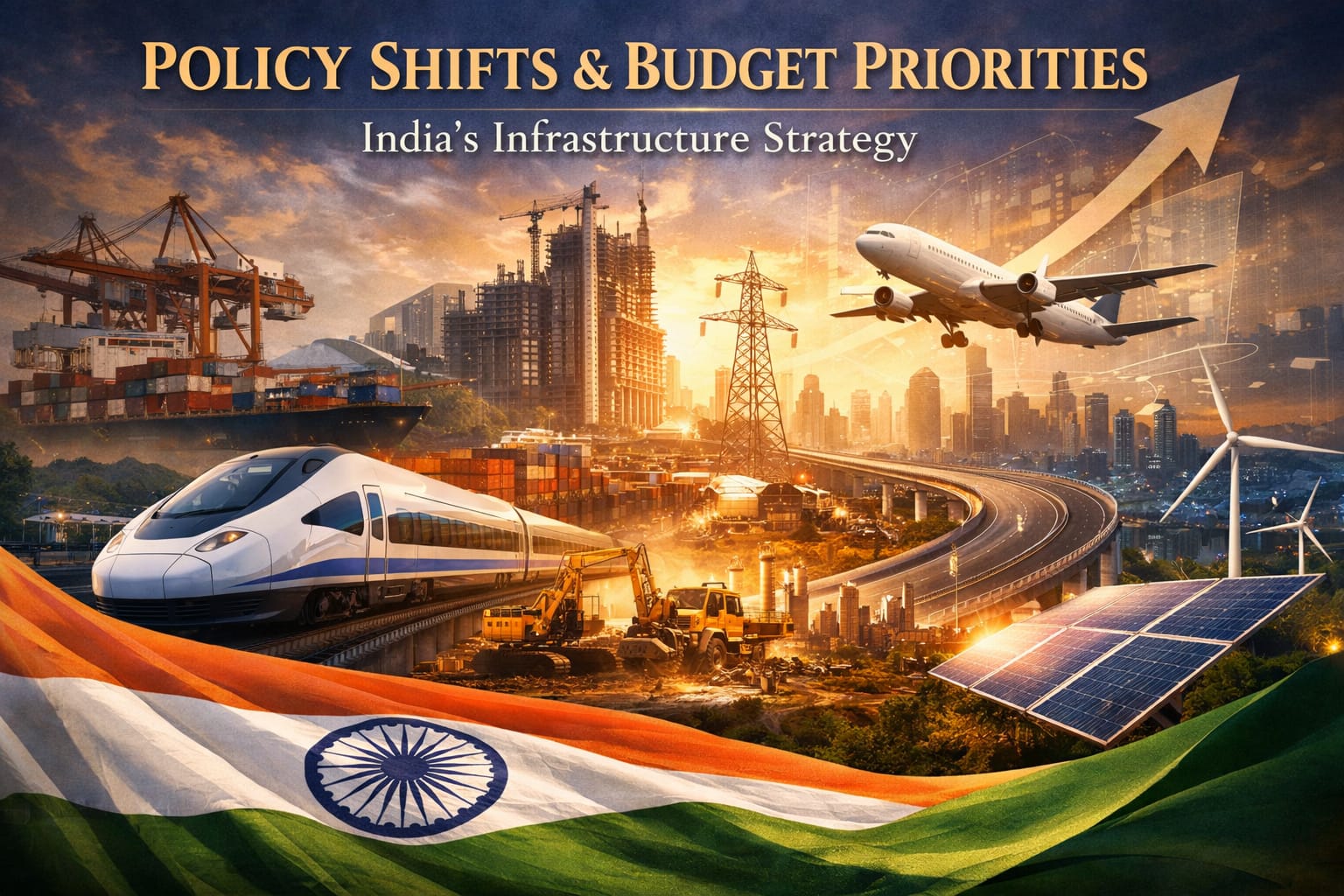
Policy Shifts & Budget Priorities: Re-Engineering India’s Infrastructure Statecraft

by Tejasvi Sharma, Editor-in-Chief, EPC World
India’s contemporary infrastructure discourse is no longer defined merely by kilometre counts, asset volumes, or expenditure aggregates. It is being fundamentally reshaped by a deeper ideological transformation – a strategic recalibration where capital expenditure is no longer treated as fiscal outlay, but as sovereign investment in national competitiveness. Infrastructure has transitioned from being a developmental instrument to becoming a geopolitical, economic, and civilisational asset class within India’s policy architecture.
At the heart of this transformation lies a decisive shift in budgetary philosophy. Infrastructure is no longer episodic or reactive in budget planning; it is now structurally embedded as a long-term growth engine. Successive budgets have institutionalised capital expenditure as a macroeconomic stabiliser, growth accelerator, and employment generator, reflecting a mature understanding that productive public investment generates multiplier effects far beyond its immediate fiscal footprint.
Yet, the current policy moment represents more than continuity. It represents evolution.
The narrative has shifted from quantitative expansion to qualitative transformation — from asset creation to asset performance, from scale to sustainability, and from speed to systemic resilience.
From Expansionism to Structural Modernisation
Earlier infrastructure cycles in India were largely driven by physical augmentation — highways, bridges, ports, power plants, housing stock, metro corridors — measured primarily in linear, volumetric, and numerical terms. Today’s policy paradigm is fundamentally different. The emphasis has moved toward efficiency, durability, lifecycle value, interoperability, and resilience.
Infrastructure is now conceived as a complex economic system, not a collection of projects.
This new orientation manifests in three distinct budgetary shifts:
1. From Output Metrics to Outcome Metrics
Success is no longer evaluated merely by kilometres built or megawatts installed, but by:
- logistics cost reduction
- asset productivity
- urban service reliability
- freight velocity
- system uptime
- operational resilience
2. From Fragmentation to Integration
Policy frameworks such as multimodal logistics planning, corridor-based development, and spatial economic clustering indicate a move away from isolated project execution toward systems architecture.
3. From Construction to Performance Economics
The focus is increasingly on asset longevity, maintenance economics, lifecycle costing, and performance assurance, redefining infrastructure as a long-term economic instrument rather than a short-term construction outcome.
Capital Expenditure as Strategic Statecraft
Public CAPEX in infrastructure now functions as economic statecraft — a deliberate tool to shape industrial geography, trade competitiveness, manufacturing localisation, and export readiness. Infrastructure investment is no longer politically symbolic; it is strategically instrumental.
This is evident in how budgetary allocations are now aligned with:
- industrial corridor development
- manufacturing clusters
- logistics optimisation
- export infrastructure
- urban economic zones
- clean energy transition
- digital public infrastructure
- mobility integration
Rather than being sector-siloed, infrastructure is now policy-networked — interwoven with trade policy, industrial policy, urban policy, climate policy, and employment policy. This convergence transforms infrastructure into a macro-economic architecture, not merely a capital programme.
Quality, Resilience and Efficiency as Budget Pillars
A defining feature of the current policy shift is the prioritisation of infrastructure quality and resilience — a response to climate volatility, urban density pressures, logistics fragility, and operational inefficiencies.
The new budgetary philosophy is underpinned by three imperatives:
1. Resilience Economics
Infrastructure is now evaluated through the lens of:
- climate adaptation
- disaster tolerance
- operational continuity
- redundancy planning
- risk mitigation
- system recoverability
Resilience is no longer a technical add-on; it is a policy requirement.
2. Efficiency Architecture
Budgets increasingly privilege:
- multimodal integration
- logistics rationalisation
- energy efficiency
- digital monitoring systems
- predictive maintenance
- operational automation
Efficiency is now treated as a national competitiveness variable, not merely an engineering concern.
3. Asset Intelligence
The integration of digital platforms, data systems, and performance analytics is creating intelligent infrastructure ecosystems — where infrastructure becomes measurable, monitorable, and optimisable in real time.
Infrastructure as Competitive Capital
Infrastructure is no longer seen as public service delivery alone — it is now viewed as competitive capital. It determines:
- investor confidence
- manufacturing viability
- logistics cost structures
- trade competitiveness
- urban productivity
- labour mobility
- export efficiency
- energy security
In this framework, budget allocations are not expenses — they are strategic investments in national power projection. This elevates infrastructure policy from economics to geopolitics.
The Emergence of Infrastructure Governance
Another significant policy evolution is the movement toward infrastructure governance, not just infrastructure development. This includes:
- standardisation frameworks
- regulatory harmonisation
- quality assurance systems
- performance audits
- lifecycle management protocols
- institutional capacity building
- procurement reforms
- transparency mechanisms
Infrastructure is now being institutionalised as a governed system, not a contractor-driven activity.
Conclusion: A New Infrastructure Doctrine
India is no longer building infrastructure merely to grow. It is building infrastructure to govern growth, stabilise growth, and strategically direct growth.
The policy shift is not about spending more — it is about spending smarter. Not about building faster — but building better. Not about expansion alone — but about endurance, intelligence, and competitiveness.
Infrastructure is no longer the foundation of development — it is the architecture of national power.
India is no longer building projects. It is building systems of strength. It is not constructing assets. It is constructing economic sovereignty. It is not funding infrastructure. It is funding the future architecture of the Indian state.
Tags