Why the IMF Rated India’s GDP as ‘C’: Signals, Subtexts, and the Future of Infrastructure Finance

by Tejasvi Sharma, Editor-in-Chief, EPC World
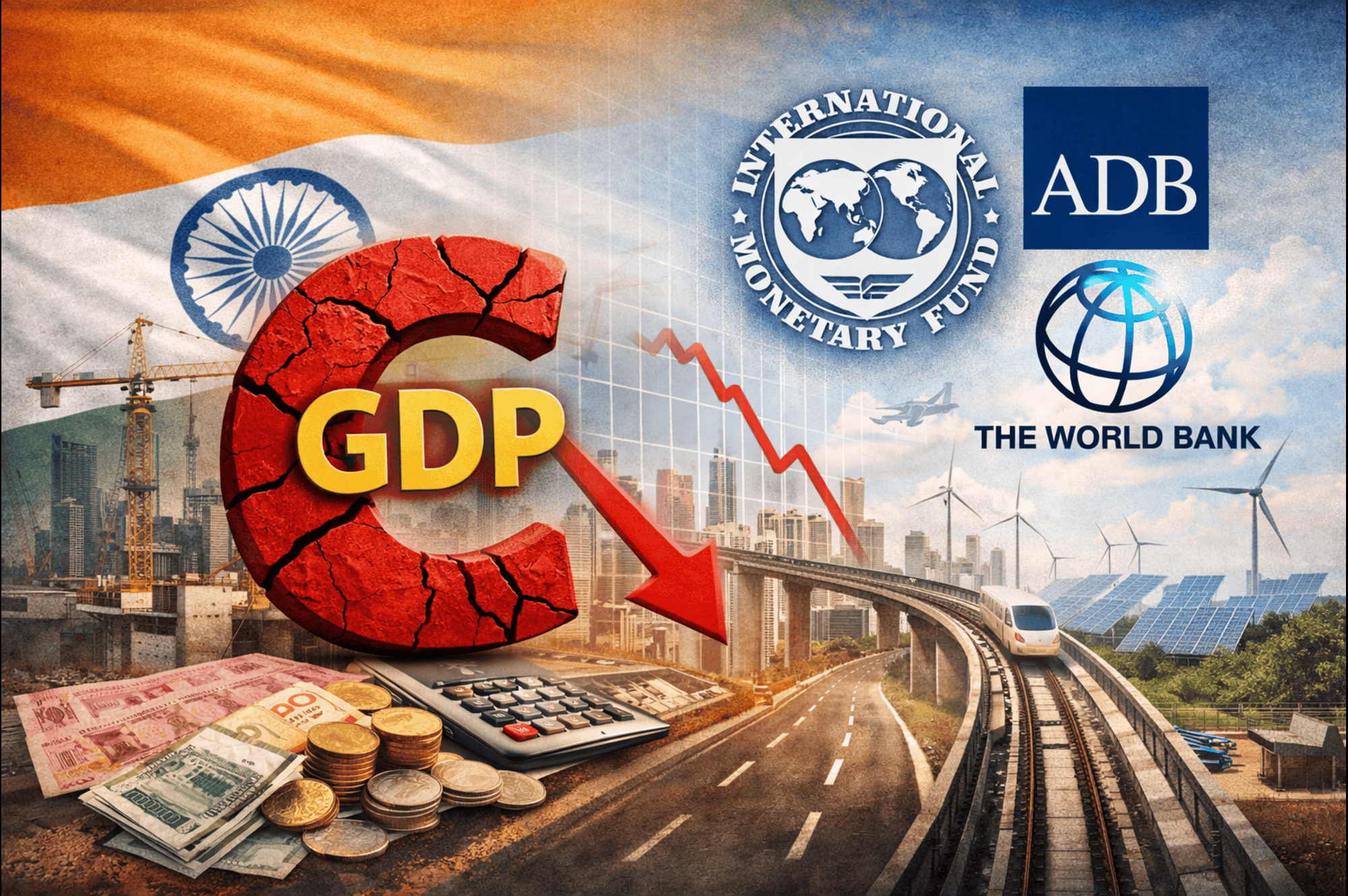
In a recent analytical classification that has stirred both consternation and curiosity within policy and financial circles, the International Monetary Fund (IMF) assigned India’s GDP performance a “C” grade—a designation that, while not catastrophic, is unmistakably cautionary. For an economy that has consistently projected itself as the fastest-growing major nation, this assessment is less a rebuke of headline growth numbers and more a forensic commentary on structural fragilities, fiscal elasticity, and the quality – not merely the quantum – of economic expansion.
At the outset, it is critical to clarify that the IMF’s “C” grading does not imply economic distress. Rather, it reflects moderate resilience amid elevated vulnerabilities. India’s GDP growth, though robust in nominal and real terms, is increasingly unevenly distributed, capex-dependent, and fiscally strained, with rising public debt, constrained consumption recovery, and external sector sensitivities forming the substratum of the Fund’s concern.
The Rationale Behind the ‘C’ Grade
The IMF’s methodology privileges sustainability over spectacle. India’s growth story, while statistically impressive, is being propelled disproportionately by public capital expenditure, particularly in transport, energy, and urban infrastructure. Private sector investment, though improving, remains cautious; household consumption has not rebounded uniformly; and real wage growth has been tepid across large swathes of the informal and semi-formal economy.
Moreover, the IMF has flagged fiscal compression masked by accounting dexterity. While headline fiscal deficit numbers appear to be on a consolidation trajectory, off-balance-sheet borrowings, contingent liabilities of public sector enterprises, and state-level fiscal asymmetries complicate the picture. Add to this a high interest-rate global environment, persistent geopolitical volatility, and climate-linked macro risks, and the “C” begins to look less arbitrary and more diagnostic.
Another undercurrent is India’s employment elasticity of growth. GDP expansion without commensurate job creation – especially in manufacturing and urban services – creates a socio-economic asymmetry that undermines long-term stability. The IMF’s assessment implicitly questions whether India’s growth is sufficiently inclusive, diversified, and productivity-led.
Implications for the Indian Economy
In the immediate term, the IMF’s grading is unlikely to precipitate capital flight or rating downgrades. India’s macro fundamentals – ample forex reserves, manageable current account deficit, and a stable banking system – provide insulation. However, the symbolic and signalling value of a “C” grade should not be underestimated.
For global institutional investors, sovereign funds, and pension capital, IMF assessments serve as risk calibration tools. A cautious grade may increase scrutiny on India’s fiscal governance, project viability, and regulatory predictability. It could marginally elevate the cost of capital for long-gestation infrastructure assets, particularly those reliant on external commercial borrowings.
More subtly, it strengthens the narrative that India must transition from state-led capex acceleration to private-sector-led productivity growth. Structural reforms in land, labour, contract enforcement, and urban governance – long discussed but unevenly executed – will return to the centre of economic discourse.
Impact on Infrastructure Funding by Multilateral Lenders
The IMF’s evaluation also has ramifications for multilateral development finance, particularly from institutions such as the World Bank and the Asian Development Bank (ADB). Contrary to alarmist interpretations, a “C” grade does not imply withdrawal of funding. However, it does signal conditional recalibration.
Future infrastructure financing is likely to become:
More selective, prioritising projects with demonstrable economic multipliers, climate resilience, and revenue visibility
More reform-linked, with disbursements tied to institutional strengthening, procurement transparency, and governance benchmarks
More sustainability-oriented, favouring green infrastructure, urban mass transit, renewable energy, and water-security projects over conventional asset-heavy models
India may also witness a shift from sovereign-guaranteed loans to blended finance structures, involving public-private partnerships, viability gap funding, and credit enhancement mechanisms. Multilateral lenders will increasingly act as catalysts rather than primary financiers, crowding in private capital rather than substituting for it.
A Constructive Inflection Point
Paradoxically, the IMF’s “C” grade could serve as a constructive inflection point. It compels policymakers to interrogate the anatomy of growth rather than celebrate its arithmetic. For the infrastructure sector, it underscores the urgency of moving beyond mere asset creation toward asset performance, lifecycle efficiency, and institutional credibility.
India’s economic destiny remains formidable. But as the IMF’s sober grading suggests, the next phase of growth will not be won by speed alone—it will be secured by depth, discipline, and durability. For an economy aspiring to global leadership, a “C” is not a verdict; it is a provocation to evolve.
Tags